
Supercharge your business with Trionex solutions. Designed for modern businesses, our platforms streamline operations, reduce costs, and maximize efficiency. Trionex have certified experts who deliver Odoo Services, Custom Development, and Enterprise Solutions designed to increase efficiency, reduce operational gaps, and support long-term digital transformation. Make smarter decisions, automate repetitive tasks, and unlock scalable growth with solutions tailored to your business needs.
Trionex provides professional Odoo Implementation services in Pakistan for companies that want clarity, control, and scalability from their ERP system.We don’t just install Odoo, we analyze your business processes, configure Odoo accordingly, and ensure it works smoothly within your existing operations. Whether you’re implementing Odoo for the first time or replacing manual systems, our focus is accuracy, stability, and long-term usability.
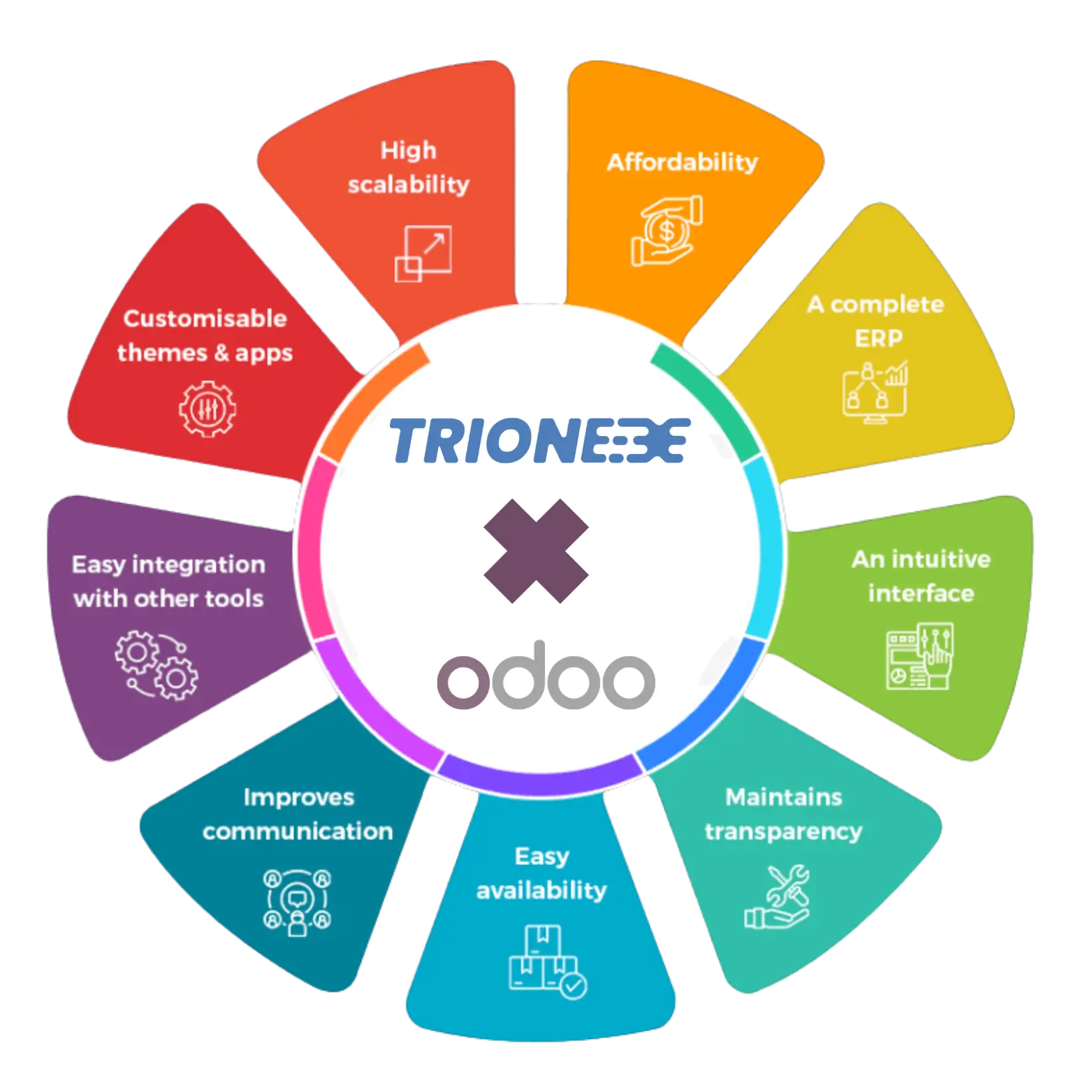
A properly implemented Odoo system does not just replace your old software. It removes the operational friction that was costing your business time and money without anyone naming it. Here is what our clients consistently report after going live.
Implementing Odoo does not mean abandoning everything your business runs on today. A well-scoped implementation connects to, migrates from, or replaces your existing tools — based on a deliberate decision, not default assumptions.
Your chart of accounts, customer balances, vendor records, and open invoices are extracted, cleaned, and migrated into Odoo Accounting during implementation. Historical financial data does not get left behind.
Odoo's Point of Sale module connects directly to inventory and accounts. Every sale updates stock in real time and posts to the correct financial account — without manual entry at end of day.
Customer records, lead history, contact details, and pipeline stages from your current CRM are migrated into Odoo CRM. Sales teams continue working with the same customer data they have built — without starting from scratch.
Whether your data lives in an older ERP, a custom-built system, or an organised collection of spreadsheets, our team extracts, standardises, and imports it into Odoo with integrity checks before any go-live is approved.
If your business relies on industry-specific tools or internally built software, we build API integrations using Odoo's REST API and XML-RPC framework to keep operations connected — without forcing you to replace tools that work.
Odoo runs across industries, but certain business types see the fastest and most measurable return from a properly structured implementation. These are the profiles we work with most in Pakistan.
Production scheduling, bills of materials, work order tracking, raw material consumption, and finished goods costing all visible in real time. Odoo Manufacturing removes the paper-based production planning that slows factory floors down.
Multi-warehouse inventory, automated reorder rules, vendor pricing, purchase approval workflows, and landed cost calculation all connected to accounting. Distribution businesses stop losing margin to invisible costs and untracked stock.
POS, e-commerce storefront, inventory, customer loyalty, and accounting in one system. Whether you run three branches or a WooCommerce or Shopify store, Odoo keeps your stock, sales, and finances in sync.
Shipment tracking, vendor management, purchase-to-receipt workflows, and multi-currency landed costs. Logistics businesses get operational visibility without maintaining separate systems for each function.
ERP implementations fail for predictable reasons most of them process problems, not software problems. Our methodology exists to close off those failure points before the project starts, not after it stalls.
Business Discovery & Gap Analysis
Solution Design & Scope Agreement
Configuration, Hosting Setup & Custom Development
Data Migration & User Acceptance Testing
Go-Live, Training & Post-Implementation Support
There are a significant number of Odoo services in Pakistan that were abandoned, rebuilt, or are running at a fraction of what was promised. These are not Odoo failures. They are implementation failures and they follow consistent patterns.
The cheapest Odoo implementation quote almost always means the discovery phase is being skipped or reduced to a single call. Configuration without thorough process mapping produces a system built on assumptions. When those assumptions are wrong and they usually are the client pays to fix them after go-live, under operational pressure, without a fallback. The total cost of a cheap-then-fix approach consistently exceeds what a structured implementation would have cost from the start.
User adoption is the factor that determines whether an ERP investment delivers its value — and adoption does not happen automatically. Teams that are not properly trained, that have no support contact after go-live, or whose questions go unanswered for days revert to old processes. Within six months, the ERP becomes a reporting tool while the real work happens in spreadsheets alongside it. Post-go-live support and active change management are not add-ons. They are what separates a successful implementation from an expensive one.
Many implementations open Odoo before anyone has documented how the client's business actually works. The result is a system configured to Odoo's default logic which is sensible for a generic business but wrong for yours. A distribution company set up like a retail business. A manufacturer with no landed cost tracking. A service company with no project-to-invoice workflow. These are not small misconfigurations. They affect every transaction the system processes and they compound over time.
UAT is not an optional formality. It is the step where real users validate the real system against real business scenarios before the business switches over. Skipping UAT means problems surface after go-live when staff are under full operational load and there is no legacy system to fall back on. Compressed UAT produces the same result: teams discover issues in production and lose confidence in the system within the first 30 days.
There are many Odoo service providers in Pakistan. The difference between them shows up not in what they claim, but in what their process actually covers. Here is what separates a Trionex engagement from a standard installation.

A complete Odoo implementation covers: business process analysis and gap identification, module selection and configuration, custom module development where standard Odoo is insufficient, data migration from existing systems, hosting setup, user acceptance testing, department-level training, go-live management, and post-launch support.
Odoo implementation in Pakistan typically takes between 6 and 16 weeks depending on scope. A small business deploying 3 to 4 standard modules with clean existing data can go live in 6 to 8 weeks. A mid-sized company with multiple departments, custom module requirements, significant data migration, and third-party integrations typically requires 12 to 16 weeks.
Yes. Odoo is well-suited for Pakistani businesses and supports local compliance requirements including FBR e-invoicing integration, Pakistan's standard chart of accounts, local payroll structures, multi-currency transactions, and multi-branch operations.
Odoo Community is the free, open-source edition. Odoo Enterprise is the licensed edition, priced per user per month, and includes all advanced modules, localisation packs, mobile access, and official Odoo S.A. support. Trionex works with both editions and advises on the right choice based on your business requirements and budget before implementation begins.
No. Many businesses can operate effectively on Odoo's standard modules with correct configuration. Standard Odoo covers the majority of business requirements out of the box.
