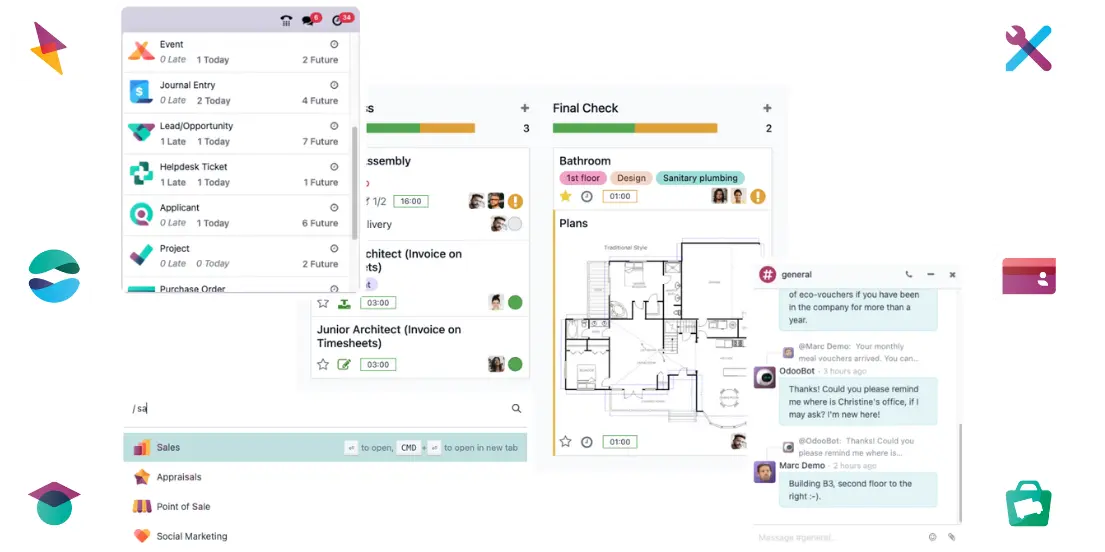
Supercharge your business with Trionex solutions. Designed for modern businesses, our platforms streamline operations, reduce costs, and maximize efficiency. Trionex have certified experts who deliver Odoo Services, Custom Development, and Enterprise Solutions designed to increase efficiency, reduce operational gaps, and support long-term digital transformation. Make smarter decisions, automate repetitive tasks, and unlock scalable growth with solutions tailored to your business needs.
Pakistan's growing businesses deserve an ERP that actually fits how they operate — not a rigid system they have to work around. Trionex is a certified Odoo silver partner in Pakistan with hands-on experience deploying Odoo across manufacturing, distribution, retail, services, and e-commerce. We configure Odoo around your workflows, not the other way around.
At Trionex, we don’t hand over a configured system and disappear. Our Odoo services in Pakistan cover the full journey from understanding how your business actually runs, to building the right Odoo environment, to training your team and supporting the system as you grow.
As expert Odoo services providers, we work across all core Odoo applications and know how each one performs in real business conditions on the ground in Pakistan. Including integration with local banking, FBR e-invoicing requirements, and supply chain setups common to Pakistani industries.
Track leads, manage your pipeline, send quotes, and close deals without switching between tools. Sales teams get full visibility from first contact to invoice in one place.
Manage receivables, payables, bank reconciliation, tax compliance, and financial reporting inside Odoo. Built to work with Pakistan’s chart of accounts and FBR reporting requirements.
Real-time stock tracking across single or multiple warehouses, automated reorder rules, lot and serial number tracking, and accurate COGS reporting. So you stop guessing and start knowing.
From bills of materials to work orders to production scheduling — Odoo’s manufacturing module gives factory floors the visibility and control they need without complex configurations.
Manage employee records, attendance, leave, and payroll calculations in one system. Reduce manual HR workload and keep employee data accurate across the organization.
Assign tasks, track project progress, manage timesheets, and keep clients updated. Whether your teams work internally or in the field, project management stays in the same Odoo environment.
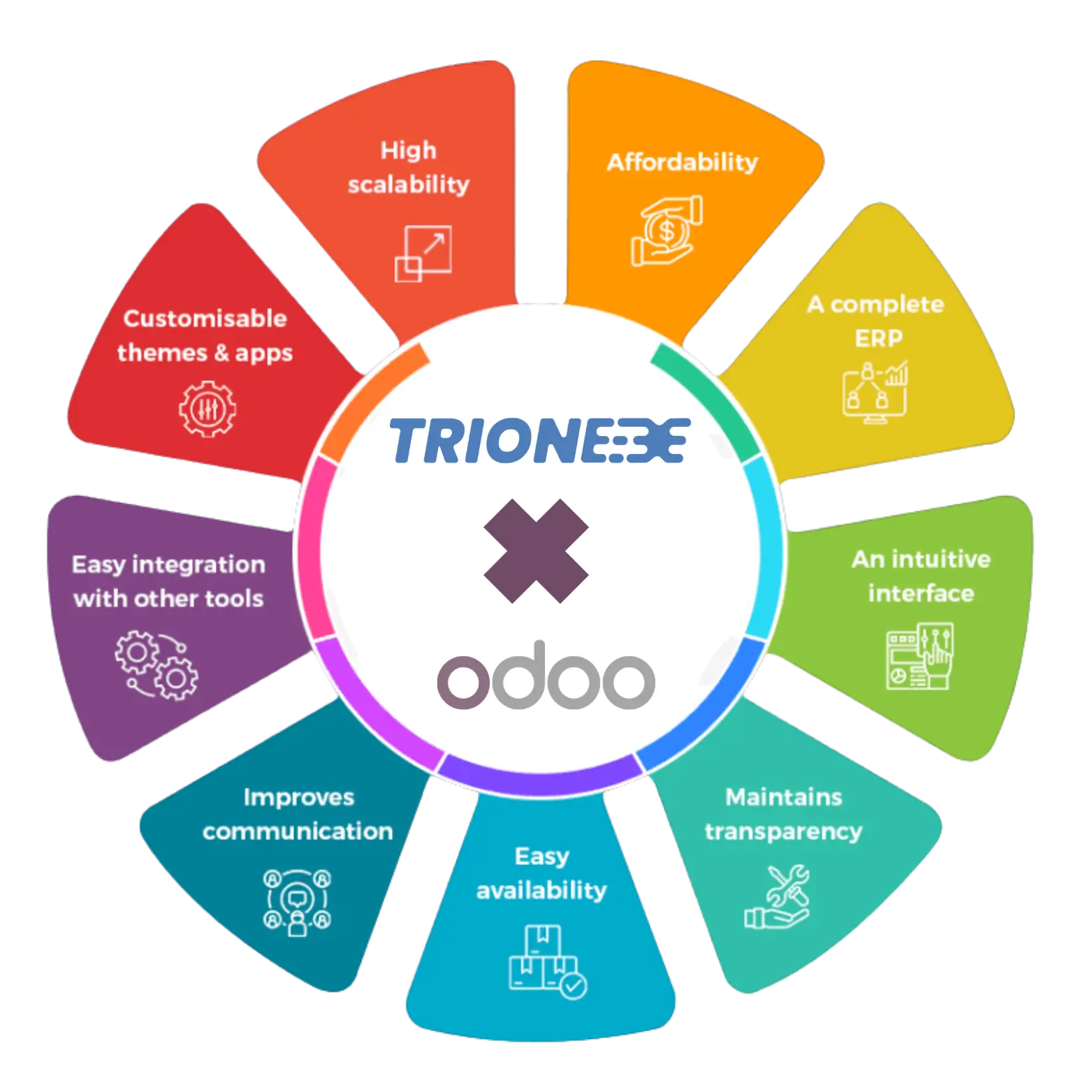
Odoo is an open-source ERP platform trusted by over 12 million users across 150+ countries, built on a modular architecture that lets businesses deploy only what they need and scale as they grow. When businesses compare SAP vs Odoo, the difference comes down to accessibility. Odoo’s licensing cost is significantly lower, the interface is built for everyday business users, and both a 10-person operation and a 500-person company can run on the same platform without overpaying for unused features.
It runs on a free Community edition and a licensed Enterprise edition, with the latter adding advanced modules, mobile apps, and direct Odoo S.A. support. That same flexibility, however, is exactly why your choice of implementation partner matters. A system configured without proper process mapping or the right module structure creates more operational problems than it solves, making a certified Odoo silver partner with a proven methodology not a luxury, but a necessity. Talk to Trionex today and get your Odoo implementation done right.
As one of Pakistan's leading Odoo silver partners, Trionex delivers every service a business needs across the full Odoo lifecycle.
End-to-end ERP deployment — from business analysis and module configuration to data migration, user training, and go-live support. We map your processes first, then build the system around them.
Standard Odoo doesn't always match every workflow. We develop custom modules, modify existing ones, and build business-specific features that make Odoo work exactly as you need it to.
Need functionality Odoo doesn't offer out of the box? Our development team builds custom Odoo modules from the ground up — integrated cleanly into your existing Odoo environment.
Connect Odoo with your existing tools payment gateways, e-commerce platforms, third-party logistics, CRMs, or custom APIs. We handle the technical integration so your data flows without gaps.
Moving from an older Odoo version or a different ERP entirely? We handle data extraction, cleaning, mapping, and migration — without losing historical records or disrupting your operations.
After go-live, your business keeps changing. Our support team handles bug fixes, performance issues, module updates, and user queries so your Odoo environment stays stable and current.
Your team needs to use Odoo confidently, not just correctly. We run structured training sessions tailored to each department and provide ongoing consultation as your business evolves.
Most businesses that come to us aren’t looking for software. They’re looking for a way out of a specific operational problem that’s costing them time, money, or both. Here is what we see most often, and what Odoo helps resolve when it is implemented properly.
Your accounts team is working in one software, inventory in another, and sales in a spreadsheet. Nobody has an accurate picture of what's happening across the business at any moment. Odoo consolidates sales, purchasing, inventory, finance, and HR into one database. So every department sees the same numbers, in real time, without manual transfers between systems.
Purchase orders created by hand, invoices typed out individually, stock counts done on paper. These tasks are slow, error-prone, and pull your team away from work that actually moves the business forward. Odoo automates repetitive workflows from reorder triggers to invoice generation to payroll calculations. So your team handles exceptions, not routine tasks.
When decision-makers have to wait for reports to be compiled, or when data from different departments doesn't match, they're making decisions based on incomplete or outdated information. Odoo's reporting and dashboard tools give owners and managers real-time visibility into sales, cash flow, production, and inventory without waiting for month-end.
A business that works fine at 50 orders a month starts breaking at 500. Manual systems, informal processes, and disconnected tools don't scale. Odoo is designed to scale with your business add users, add companies, add warehouses, add new workflows without rebuilding your system from the ground up.
You have a working e-commerce store, a payment gateway your customers trust, or a third-party logistics partner. A new ERP that can't connect to these creates double work. Trionex integrates Odoo with your existing ecosystem — WooCommerce, Shopify, payment gateways, shipping APIs so your operations stay connected, not siloed.
When the same customer exists in five different formats across three different systems, or when inventory figures don't match purchase records, you're dealing with a data reliability problem. Odoo centralizes all business data in one structured system, with access controls and audit logs so records are consistent, traceable, and audit-ready.
Before touching any configuration, we spend time understanding how your business actually works, how orders are processed, how stock is tracked, how invoices are created, and where the current system breaks down. This discovery phase produces a clear requirements document that guides everything that follows. We identify which Odoo modules are needed, which ones require customization, and what integrations need to be built.
With a clear picture of your requirements, we create a detailed implementation plan. This covers module configuration, data structure, user roles and access levels, integration points, and a realistic timeline with milestones. The blueprint is reviewed and approved by your team before development begins so there are no surprises later.
With a clear picture of your requirements, we create a detailed implementation plan. This covers module configuration, data structure, user roles and access levels, integration points, and a realistic timeline with milestones. The blueprint is reviewed and approved by your team before development begins — so there are no surprises later.
Before going live, the system goes through structured testing — functional testing of each module, integration testing across connected systems, performance testing under realistic data loads, and user acceptance testing with your team. Issues identified in testing are resolved before go-live, not after.
We manage the go-live process to minimize disruption. This includes data migration from your existing systems, a parallel-run period where needed, and hands-on support during the transition. After go-live, Trionex remains your Odoo silver partner — available for system updates, performance tuning, additional module deployment, and any issues that come up as your business evolves.
There are several Odoo silver partners in Pakistan. What separates one from another is not what they promise, it is what they can demonstrate. Here is what makes working with Trionex different in practice.
A certified Odoo silver partner is a company that has been evaluated and approved by Odoo S.A. to implement, customize, and support Odoo ERP for businesses. Certification means the partner's team has passed Odoo's technical and functional assessments, and the company meets Odoo's quality standards for client delivery. Working with a certified partner gives businesses access to Odoo's full enterprise feature set, official support pathways, and implementation expertise that non-certified vendors cannot provide.
Odoo implementation cost in Pakistan depends on the number of modules being deployed, the level of customization required, data migration complexity, and the size of the business. A basic implementation for a small business can start from a few hundred thousand rupees, while a full-scale deployment for a mid-market company with custom modules and integrations will cost more. At Trionex, we provide a detailed scope and fixed-price quote before any work begins — so you know exactly what you are committing to.
A standard Odoo implementation at Trionex takes between 6 to 16 weeks depending on scope. A smaller business deploying 3–4 modules with clean existing data can go live in 6–8 weeks. A larger company with multiple departments, custom workflows, and data migration from an older system typically takes 12–16 weeks. Rushing this timeline to cut costs is one of the most common reasons ERP implementations fail.
Odoo is an all-in-one business management platform that covers accounting, inventory, sales, CRM, purchasing, HR, manufacturing, project management, e-commerce, and more all connected in a single system. Businesses use Odoo to replace disconnected tools and manual processes with one integrated ERP environment.
Yes. Odoo has an open API framework that allows integration with external platforms including e-commerce stores (WooCommerce, Shopify), payment gateways, third-party logistics platforms, CRMs, and custom internal tools. Trionex handles both standard Odoo connectors and custom API integrations depending on what your existing systems require.
For small businesses in Pakistan, Odoo is widely considered the most practical ERP option — primarily because of its modular structure (you only pay for what you use), lower licensing cost compared to SAP Business One or Oracle NetSuite, an interface business users can learn quickly, and a large support community. Other options include Microsoft Dynamics 365 and ERPNext, but Odoo's balance of functionality, cost, and flexibility makes it the most commonly implemented ERP for Pakistani SMEs.
Data migration to Odoo involves four stages: extracting data from your current system, cleaning and standardizing it to match Odoo's data structure, importing it using Odoo's built-in import tools or custom migration scripts, and validating accuracy before go-live. The cleanliness of your existing data is the biggest factor in how smooth the migration goes. Trionex includes structured data migration in every implementation engagement and provides a migration checklist your team prepares against before the import begins.