A finance manager in Lahore should not have to wait until month end to discover that a customer account is overdue. A retail operator in Karachi should not need three spreadsheets to understand stock across branches. A service company in Islamabad should not depend on someone remembering to follow up on every quotation.
Enterprise resource planning is moving into a new phase. Earlier ERP projects focused on bringing departments onto one database. The next phase is about helping that database interpret information, suggest the next action, reduce repetitive work, and give people useful answers without another report-building exercise.
For Pakistani businesses, this shift matters because growth is happening alongside practical constraints: limited specialist teams, fragmented legacy data, pressure for faster customer service, multi-branch operations, tax reporting requirements, and intense competition on price. Intelligent automation will not remove the need for managers or accountants. It will change where their time is spent.
What is changing inside modern ERP?
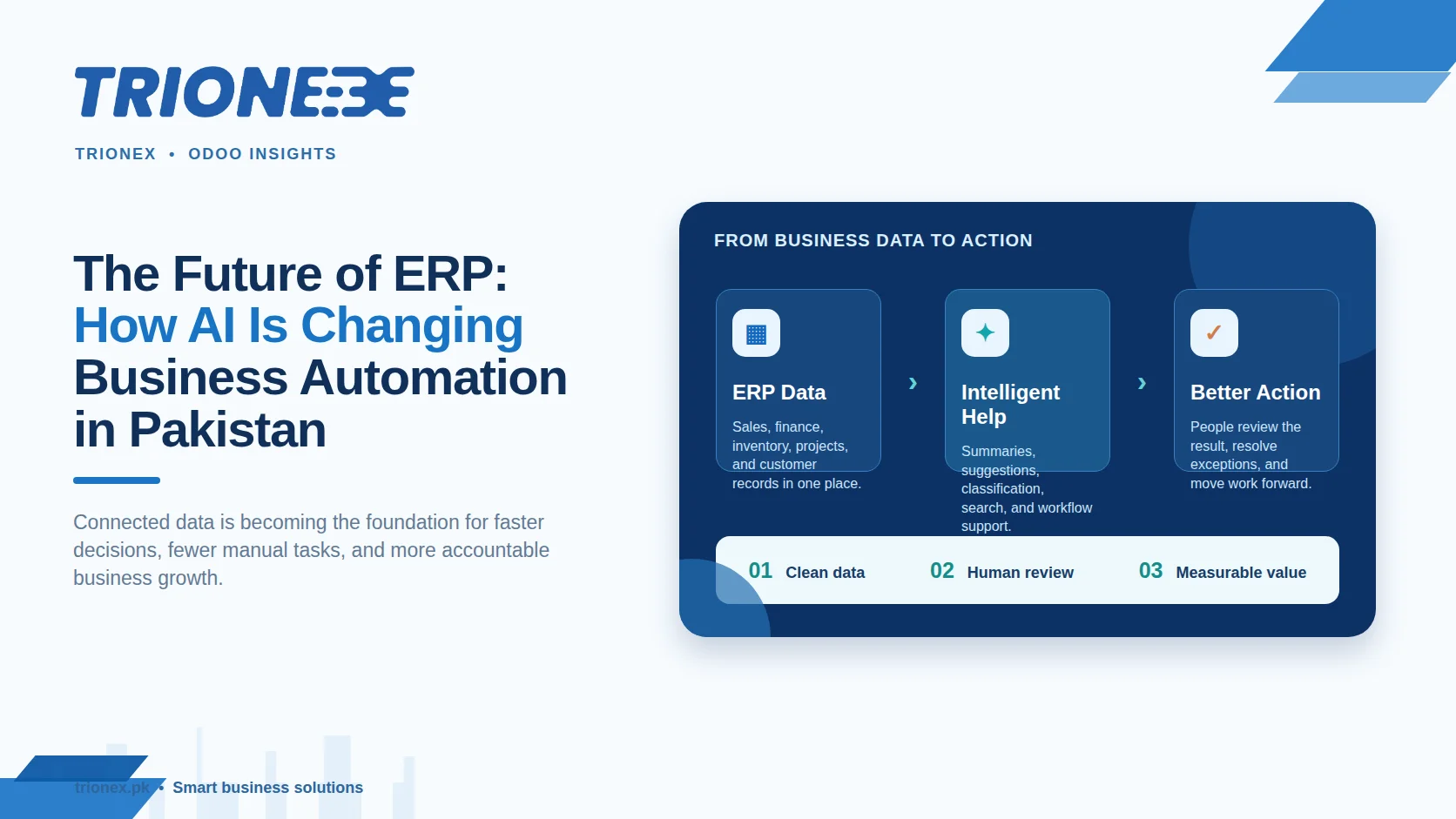
Modern ERP is changing from a system that records transactions into a system that can assist with decisions and routine actions. A traditional ERP records a sale, purchase, payment, stock movement, or employee record. A more capable ERP can use that same operational context to identify a pattern, prepare a response, classify a document, or prompt a responsible user.
The distinction is important. Intelligent ERP is not a separate robot sitting beside the business system. Its value comes from working with trusted records and existing permissions. A sales assistant can receive a suggested follow-up based on an opportunity. An accounts team can receive help extracting information from a vendor bill. A manager can ask for a summary of a support conversation or a project update.
The best systems keep a human review point for financial, legal, customer, or operational decisions.
Why is this shift important for Pakistan?
The shift is important for Pakistan because businesses need to scale output without expanding every manual process at the same rate. A growing retailer adds stores, a distributor adds SKUs, and a software company adds clients. If every new transaction creates another spreadsheet, approval message, or reconciliation task, growth eventually becomes operational pressure.
Pakistani companies also work across very different levels of digital maturity. One department may use a modern e-commerce platform while another still depends on paper approvals. Customer and product data may be duplicated in a point of sale system, accounting software, Excel files, and messaging applications. Before any automation is introduced, these records need to be connected and standardised.
That is why a business should first establish a dependable ERP foundation. Trionex’s Odoo services in Pakistan are built around connecting sales, accounting, inventory, manufacturing, HR, projects, and service operations before adding advanced automation on top.
Which ERP tasks can intelligent automation improve?
The strongest early use cases are repetitive, rule-based tasks that involve large volumes of documents, messages, or routine decisions. Businesses should start with a measurable bottleneck, not with a vague ambition to “use AI everywhere.”
Practical examples include:
- Extracting supplier, amount, date, and tax information from vendor bills
- Classifying documents and sending them to the right folder or workflow
- Drafting customer replies or summarising long conversations
- Suggesting the next activity for a sales opportunity or support ticket
- Finding records and opening the correct view through a natural language request
- Identifying overdue follow-ups, unusual transactions, or incomplete records
- Summarising sales, inventory, project, or service data for a manager
- Forecasting demand when historical data is sufficient and reliable
Odoo’s current AI features include Ask AI assistance within the database, content improvement, summaries, suggested next steps, document sorting, AI fields, voice transcription, and configurable agents. The standard Ask AI assistant can answer questions and open views, but it does not change database records by default. That boundary is useful because it preserves review and accountability.
How can ERP improve sales and customer relationships?
ERP improves sales by connecting customer history with the next action instead of leaving follow-up to personal memory. A lead can move through CRM, quotation, sales order, delivery, invoice, and support without the customer record being recreated at each stage.
An assistant can help a sales representative summarise the last conversation, draft a follow-up email, identify unanswered questions, or suggest a relevant activity. These are small interventions, but they matter when a team is managing hundreds of opportunities. Faster responses also make it easier for a manager to see which opportunities are active, stalled, or waiting for a customer decision.
The quality of the result depends on the quality of the CRM data. If contact names are duplicated, opportunity stages are inconsistent, or sales staff do not record activity, no assistant can produce a dependable pipeline view. Automation exposes weak processes quickly, which is one reason Odoo implementation should begin with process mapping and data standards.
What changes in finance and accounting?
In finance, intelligent automation reduces manual data entry while keeping approvals, tax treatment, and reconciliation under controlled review. Accounts teams spend a significant amount of time moving information from bills, receipts, emails, bank statements, and spreadsheets into the accounting system.
Document recognition can help capture values from incoming bills. Rules can route documents, suggest accounts, flag missing information, or match transactions with existing records. A finance manager can ask for a summary of receivables or expenses instead of waiting for a manually prepared report.
This does not mean every suggested account or tax value should be accepted automatically. Pakistani businesses need to pay attention to sales tax, withholding tax, currency, chart of accounts, approval limits, and audit trails. Automation should make review faster and more consistent, while responsibility remains with the authorised finance team.
Digital invoicing also makes connected finance more important. The Federal Board of Revenue states that electronic invoicing is mandatory for corporate and non-corporate registered persons under the cited rules, with notified ERP, POS, or invoicing systems integrated through a licensed integrator. Businesses should verify their current obligations and implementation route with qualified tax and integration professionals rather than treating a generic software feature as compliance.
Can automation make inventory more predictable?
Automation can make inventory more predictable by combining sales history, stock movements, purchasing, and warehouse rules in one operational record. The goal is not to create a perfect forecast. The goal is to identify likely shortages, slow-moving stock, replenishment needs, and exceptions early enough to act.
For retail and distribution companies, an ERP can show stock by branch, warehouse, product, lot, or serial number. Reordering rules can trigger purchasing when quantities reach a defined threshold. Managers can compare demand patterns with supplier lead times before committing cash to inventory.
Forecasting must be treated as an input to a decision, not as a replacement for local knowledge. Seasonal demand, import delays, exchange-rate changes, promotions, electricity interruptions, and supplier behaviour may not be represented accurately in historical data. The operations team still needs to review the recommendation.
Companies consolidating old stock records can use Odoo migration and upgrades to clean and map products, customers, vendors, opening balances, and historical information before building new automation rules.
How will manufacturing and field operations benefit?
Manufacturing and field operations benefit when the ERP can connect planning signals with the work happening on the ground. A manufacturer needs visibility into bills of materials, raw material availability, production orders, quality checks, and finished goods. A field service team needs job assignments, parts, travel, customer history, and completion records.
Automation can highlight a production order at risk because a component is unavailable. It can suggest a task assignment based on skills or location. It can prepare a service summary from technician notes or remind a manager that a job is waiting for a customer sign off.
These workflows require more than a chatbot. They depend on accurate product masters, realistic lead times, defined approval stages, and disciplined field data. Where standard Odoo does not cover a specific operation, custom development and API integration can connect an external device, portal, marketplace, or industry system without abandoning the central ERP record.
What does responsible adoption look like?
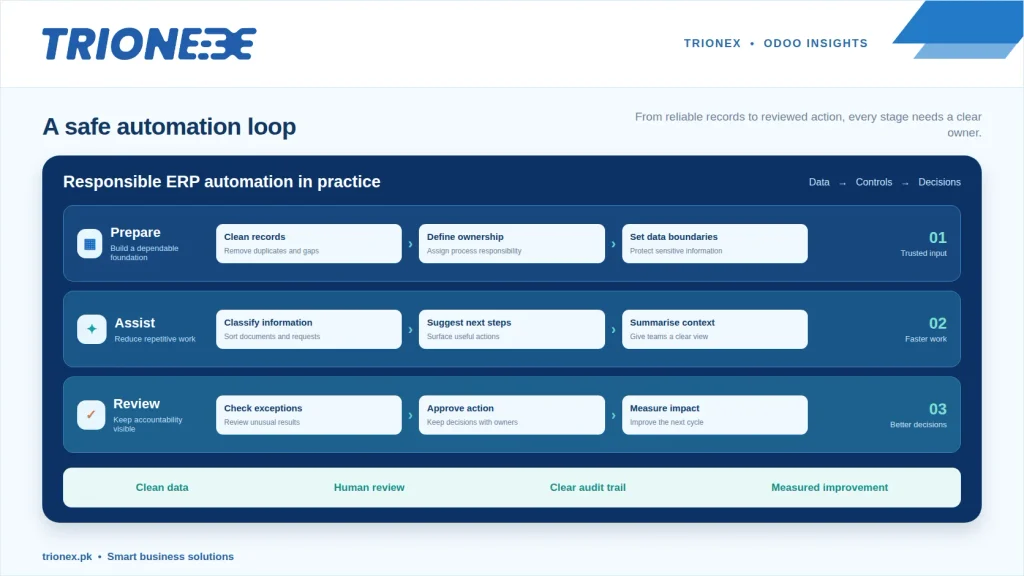
Responsible adoption means giving automation a defined purpose, controlled access, verified data, and a clear human owner. A company should be able to answer five questions before enabling an automated action:
- What business problem is being solved?
- Which records and data sources are being used?
- Who can view, approve, correct, or reverse the result?
- What happens when the suggestion is wrong or the data is incomplete?
- How will the business measure whether the workflow improved?
Pakistan’s National AI Policy places emphasis on innovation, workforce readiness, secure and ethical use, data protection, and responsible sector transformation. Those priorities have a direct business implication. Companies should not send sensitive customer, employee, financial, or commercially confidential information into an uncontrolled tool simply because it offers a quick answer.
Access rights, audit logs, data retention, vendor terms, backups, and staff training are part of the automation project. They are not technical details to be considered after launch.
How should a Pakistani business start?
A Pakistani business should start with one high-volume workflow, clean the underlying data, and measure the result before expanding. A sensible sequence is:
- Document the current process and the cost of its delays or errors
- Select a workflow such as vendor bill capture, lead follow-up, stock replenishment, or support triage
- Confirm the Odoo apps, integrations, permissions, and data required
- Clean duplicate records and define ownership of key fields
- Configure the workflow with a human approval point
- Test it with real but controlled business scenarios
- Measure time saved, error reduction, response speed, revenue leakage, or user adoption
- Expand only after the first workflow is stable
This creates evidence for prioritising the next process.
What will separate successful ERP projects from failed ones?
Successful ERP projects will be separated by data quality, process ownership, integration discipline, and user adoption rather than by the number of features switched on. A business can have advanced tools and still produce poor results if customer records are duplicated, product codes are unreliable, or employees bypass the system.
The implementation partner also matters. Trionex combines Odoo consulting, configuration, custom development, integration, migration, training, and support so the business can build a connected operating model rather than a collection of isolated features. A relevant example is Trionex’s ISP operations case study, where automation connected provisioning, billing, support, inventory, usage data, and compliance reporting around operational needs.
The future of ERP in Pakistan will not be defined by the loudest technology claim. It will be defined by businesses that make trustworthy data available, automate the right decisions, keep people accountable, and use connected systems to serve customers better.
Frequently asked questions
Does automation remove the need for an ERP implementation partner?
No, automation increases the importance of good implementation because suggestions depend on clean data, defined processes, integrations, and permissions. A partner helps convert a business requirement into a workflow that users can operate and audit.
What is the best first AI automation for a small business?
The best first automation is usually a repetitive workflow with visible volume and a simple success measure, such as bill data capture, lead follow-up, document classification, or stock alerts. Start small, validate the result, and then expand.
How can Trionex help with AI-enabled ERP?
Trionex can help businesses assess processes, implement Odoo, connect third-party systems, develop custom modules, migrate data, train users, and support automation after go-live. Contact info@trionex.pk or +92 311 4994809 to discuss a practical starting point.
Tagged with :