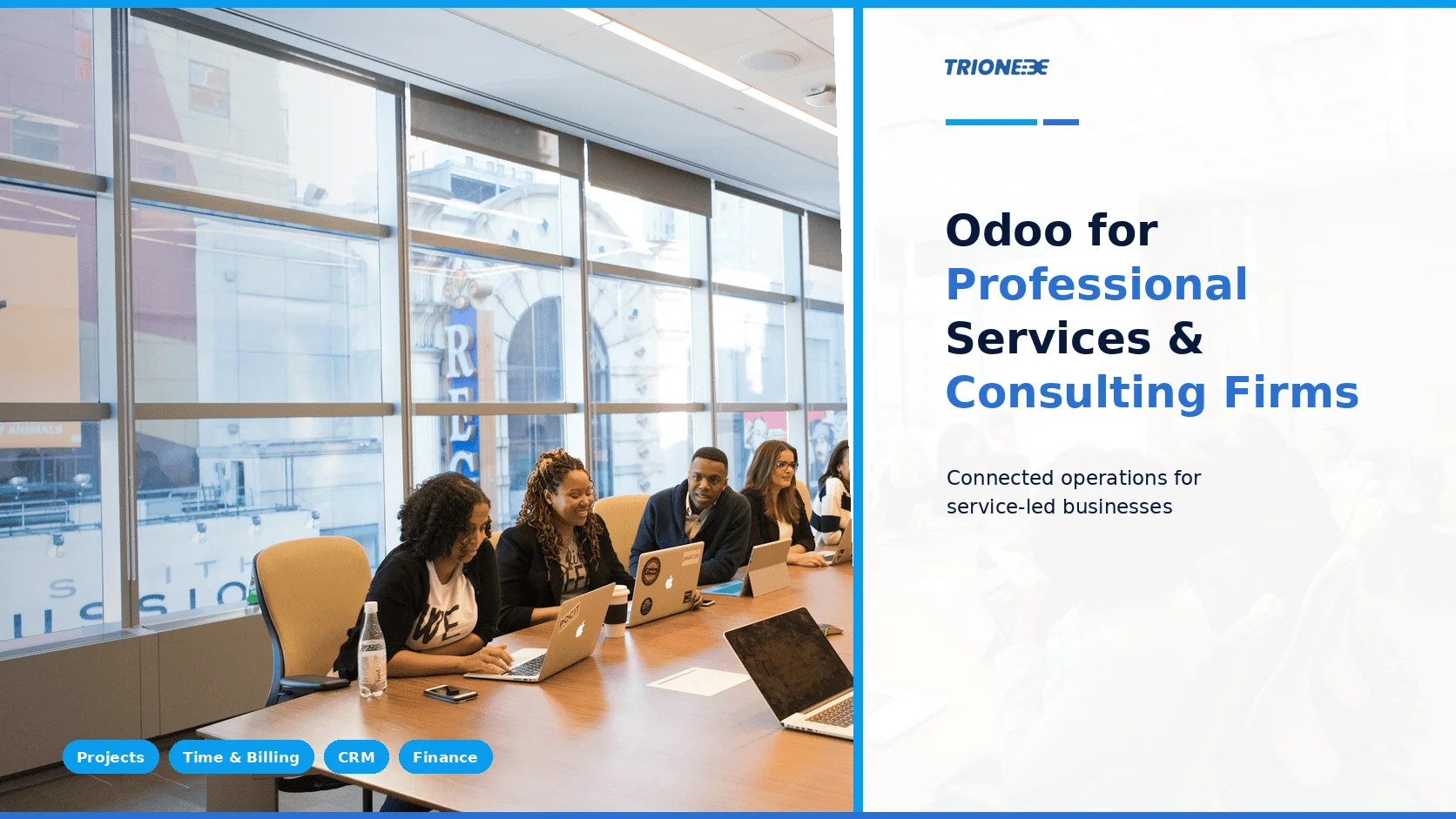
Consulting practices, legal firms, IT agencies, and engineering consultancies rely heavily on human capital, billable time, and client satisfaction. Unlike business models focused on physical inventory and manufacturing, professional service businesses sell expertise, project deliverables, and time. Managing these engagements through separate applications creates operational bottlenecks, unbilled hours, and delayed financial reporting.
Modern consulting businesses need end-to-end operational visibility. Leadership teams must track sales leads, schedule consultant capacity, monitor project milestones, and issue timely client invoices from a single system. Implementing Odoo services provides a modular approach to operational efficiency, replacing fragmented tools with an integrated software platform built for scalability.
What Operational Challenges Do Consulting Firms Face?
Professional services organizations deal with complex client projects, changing scopes, and distributed teams. Without a centralized platform, managers struggle to maintain full oversight of ongoing engagements.
Why is tracking billable hours so difficult?
Consultants often work across multiple client accounts in a single week. When staff record hours across disparate spreadsheets, chat threads, or standalone timesheet applications, administrative errors occur. Minor unrecorded hours accumulate quickly into significant revenue leakage. Delayed timesheet submissions also prevent accounting teams from issuing accurate customer invoices on schedule, causing avoidable cash flow delays.
How do isolated systems harm client communication?
Sales representatives manage client discussions in a dedicated CRM tool, while project managers track milestones in separate project boards. Finance departments handle billing using independent accounting tools. Because these systems do not communicate automatically, staff spend valuable hours manually re-entering contract details and project hours. Important project updates reach clients late, which lowers trust and increases administrative friction.
Why does scope creep hurt project margins?
Unplanned task requests often occur during long consulting engagements. When project managers lack real-time visibility into baseline budgets and ongoing hour consumption, additional work goes unbilled. Without direct integration between project deliverables and invoicing modules, businesses end up absorbing the cost of extra labor hours.
What Causes Workflow Friction in Service Businesses?
Workflow friction happens when business processes rely on disconnected systems and manual data transfers between departments.
Why do spreadsheets fail as companies scale?
Small and medium enterprises (SMEs) frequently start their operations using spreadsheets for scheduling, timesheets, and expense tracking. While spreadsheets work well for small teams, they become unreliable as project volume increases. File duplication creates conflicting versions of client data. Manual data entry introduces user errors, leaving operations leaders without trustworthy data for decision-making.
How does poor resource visibility hurt project profit?
Assigning the right consultants to projects requires clear visibility into staff availability, skill sets, and current commitments. When resource planning tools function independently from project timelines, resource managers overbook key team members while leaving other consultants underutilized. These resource allocation gaps cause project delays and lower overall profit margins.
Why does month-end financial reconciliation take so long?
When customer payments, consultant expense reports, and project billing exist in separate databases, accountants must cross-reference data across spreadsheets manually. Reconciling month-end financial records becomes a time-consuming project. Financial reports generated weeks after month-end prevent leadership from taking swift corrective action on unprofitable projects.
How Does Odoo Unify Consulting Operations?
Odoo ERP connects essential operational tools into a unified platform. By integrating core functions within a shared database, professional service businesses maintain total control over sales, execution, billing, and reporting.
How does Odoo integrate CRM and sales pipelines?
The service lifecycle starts during the sales process. Odoo CRM manages prospect interactions, sales leads, and formal proposals. When a prospect signs a digital contract, Odoo automatically initiates downstream processes. The system generates a dedicated project board, creates milestone tasks, and assigns billing rules directly from the approved sales order, eliminating manual configuration delays.
Can project management directly feed customer invoicing?
Odoo Project integrates directly with timesheet logging and billing tools. Team members assign billable and non-billable hours to specific project tasks through desktop or mobile interfaces. The system compares recorded hours against agreed contract terms, whether based on time-and-materials or fixed-price milestones. Approved timesheets automatically generate customer invoices, guaranteeing accuracy and accelerating billing schedules.
How does real-time accounting improve financial visibility?
Integrated accounting tools gather data instantly from approved expenses, vendor bills, project hours, and customer invoices. Real-time executive dashboards display project profitability, billable utilization rates, and incoming revenue projections. Operations leaders monitor profit margins at any stage without waiting for manual month-end reports.
How do HR and expense modules assist team management?
Consultants incur billable expenses such as travel and project materials while managing client accounts. Odoo HR and expense management applications allow employees to submit receipts instantly via mobile devices. Managers review and approve expense claims online, while the system links billable expense items straight to client invoices for reimbursement.
| Operational Area | Disconnected Software Tools | Integrated Odoo ERP Platform |
|---|---|---|
| Sales to Execution | Manual data transfer between CRM and project tools | Automated project creation from closed sales orders |
| Time Tracking | Isolated spreadsheets vulnerable to user errors | Direct task logging linked directly to client billing |
| Financial Reporting | Delayed month-end compilation across tools | Real-time executive dashboards and profit metrics |
| Resource Planning | Uncoordinated schedules causing staff bottlenecks | Centralized capacity planning and skill matching |
What Are the Limitations of Odoo for Service Firms?
While Odoo offers comprehensive functionality, professional service organizations must understand system limitations and technical considerations prior to deployment.
Does Odoo require initial configuration?
Odoo includes pre-configured operational templates, but complex consulting workflows require customized setup. Businesses with multi-tiered billing rules, complex partner revenue splits, or specialized approval paths require careful system architecture planning. Deploying standard settings without expert adjustment can cause user confusion and workflow interruptions.
How critical is team change management?
Moving from familiar spreadsheets or legacy tools to an enterprise platform requires structured user training. Staff members must adjust to standardized time tracking and digital approval processes. Without systematic user training and clear management guidance, staff may revert to informal routines, reducing overall data quality.
How Should You Plan Your Odoo Implementation?
A structured implementation roadmap reduces system downtime, maintains data integrity, and protects daily business operations.
What steps ensure smooth data migration and adoption?
Consulting firms should follow a methodical roadmap when transitioning to Odoo. Partnering with an experienced tech partner ensures proper workflow optimization, system integration, and security controls.
- Phase 1: Workflow Analysis & Process Mapping: Review existing business processes, identify operational bottlenecks, and outline exact software requirements.
- Phase 2: Architecture & System Configuration: Set up essential Odoo modules, including CRM, Project, Accounting, and HR, aligning software rules with operational policies.
- Phase 3: Data Migration & Security Setup: Clean historical customer records, active project logs, and financial balances before executing data migration into the secure Odoo database.
- Phase 4: Integration & Custom Software Adjustments: Connect external third-party software tools and configure custom software rules where standard module settings fall short.
- Phase 5: User Training & System Validation: Conduct department-specific training sessions and run realistic testing scenarios to confirm system accuracy.
- Phase 6: Go-Live & Ongoing Management: Launch the cloud adoption phase, monitor live transactions, and provide continuous long-term support for operational growth.
If your organization requires unique business rules or customized software connections, exploring custom software development ensures that your final system architecture perfectly supports your business model.
How Does Odoo Scale with Growing Business Needs?
Growing enterprise systems require software platforms that expand alongside business operations. Odoo features a modular architecture, allowing businesses to activate additional software modules as requirements evolve over time. Emerging firms can launch core functions like CRM and project tracking first, later adding advanced workflow automation, vendor purchase management, and enterprise reporting tools. Through tailored enterprise solutions, expanding consultancies maintain operational efficiency without replacing their core software stack.
How Can Trionex Assist Your System Transformation?
Modernizing your consulting operations requires technical expertise, business process alignment, and ongoing system support. Trionex works with business owners, operations leaders, and technology decision-makers to design, deploy, and maintain Odoo platforms tailored to modern service management.
Trionex presents itself as an Odoo partner in Pakistan, offering digital transformation, business automation, and data management services. Whether you need system integration, workflow optimization, or long-term system management, our team works with Odoo developers, custom developers, and enterprise experts to build an efficient, unified operational ecosystem. If you are ready to eliminate fragmented tools and improve project visibility, contact Trionex today to speak with our technology consultants.
Tagged with :