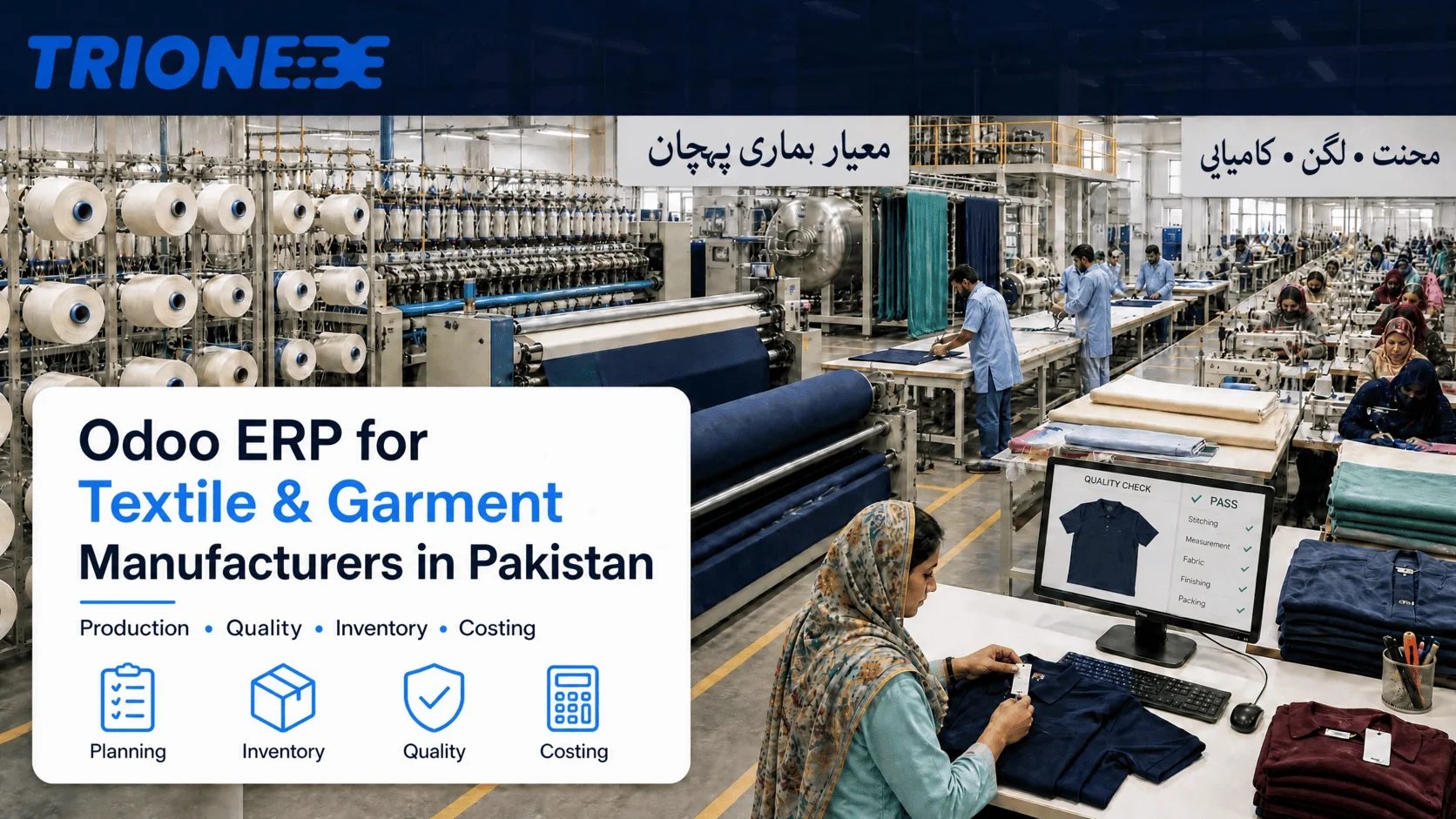
Textile is not manufacturing in the generic sense. A steel fabricator turns raw material into a finished part in a handful of steps. A garment goes through spinning or sourcing, weaving or knitting, dyeing and finishing, cutting, stitching, and packing, often with different units of measure and different subcontractors at each stage. Pakistan’s textile and garment sector runs on this complexity every day, and most standard ERP thinking simply was not built for it.
Why textile production breaks a generic manufacturing template
A single garment BOM might start in kilograms of yarn, convert to meters of fabric, and end in pieces of finished clothing, with waste and shrinkage at every conversion. A system that assumes one unit of measure from raw material to finished good falls apart quickly here. Odoo for textile handles this through multi-level BOMs with unit conversions built into each stage, so a spinning unit, a weaving unit, and a garmenting unit can each work in the measure that makes sense for their process while the system keeps true costing intact end to end.
The stages Odoo actually needs to track
- Spinning and weaving or knitting: raw fiber or yarn consumption tracked against output, with waste percentage visible per batch
- Dyeing and finishing: batch and lot tracking, since color and finish variations need to be traceable back to the source batch, especially for export orders with strict buyer specifications
- Cutting and stitching: work orders broken down by size and style, where a single fabric roll can yield dozens of SKU variations
- Quality checks between stages, not just at the end, since a defect caught after finishing costs far more to fix than one caught after cutting
Job work and subcontracting
A large share of Pakistan’s textile output does not happen entirely in one factory. Dyeing might be subcontracted to a specialist unit. Embroidery or washing might go to a separate job worker entirely. This is normal in the industry, but it is exactly the kind of thing that turns into a black hole in a spreadsheet: material goes out, and nobody has a clean, real-time answer for what came back, when, or at what cost. Odoo for textile & garments tracks subcontracted operations as part of the same manufacturing order, so outsourced stages stay visible instead of disappearing into a separate WhatsApp thread with a job worker.
The export compliance layer
Pakistan’s textile sector is export-heavy, and that brings its own paperwork on top of standard FBR compliance. Zero-rated sales tax status for qualifying exports, Section 153 withholding tax on supply contracts, and EOBI or PESSI payroll deductions across large factory workforces all need to be handled correctly and consistently, not reconstructed at year-end. Many export buyers also require Sedex or BSCI-style documentation trails, which is far easier to produce from a system that already tracks batches, quality checks, and worker records than to assemble after the fact.
This is already working in Pakistan’s textile sector
This is not a theoretical fit. Odoo’s own published customer references include real Pakistani textile and garment companies already running production on it: a Karachi-based woven garment exporter supplying European retailers, a long-established terry towel manufacturer, and multiple fabric, garment, and home textile operations across the country. The industry has already been testing this for years, not just accepting a vendor’s pitch on faith.
Where this differs from a general manufacturing setup
Our broader guide to Odoo for manufacturing business in Pakistan covers the core production flow that applies across industries: BOMs, work orders, and costing. Textile needs everything in that guide, plus the unit-of-measure handling, job work tracking, and export documentation covered here. Getting this configuration right usually needs one of the established Odoo partners in Pakistan who has actually set up multi-stage BOMs and subcontracted work orders before, not someone applying a generic template.
Common mistakes in textile rollouts
- Treating every size and color as a manual variant instead of using Odoo’s product variant structure, which quickly becomes unmanageable at real SKU volumes
- Skipping waste and shrinkage tracking at go-live, then trying to retrofit accurate costing months later
- Not mapping job work relationships properly, which recreates the same visibility gap the new system was supposed to fix
- Underestimating how long export compliance configuration takes compared to the production side, and leaving it until the last stage of the project
Most of these come down to rushing the setup phase. Well-planned Odoo implementations for textile factories usually spend more time mapping the actual production flow before go-live than businesses expect, and that upfront time is what prevents the mistakes above.
Built for how Pakistani textile businesses actually operate
Trionex has worked directly with Sapphire, one of Pakistan’s largest vertically integrated textile groups, spanning production through to its own retail stores, the kind of business where Odoo for retail and manufacturing genuinely have to work as one connected system rather than two separate projects. Trionex is an Odoo Silver Partner based in Lahore, and if your production runs across multiple stages, subcontractors, or export markets, we can walk through what a proper setup would look like for your specific process.
Tagged with :