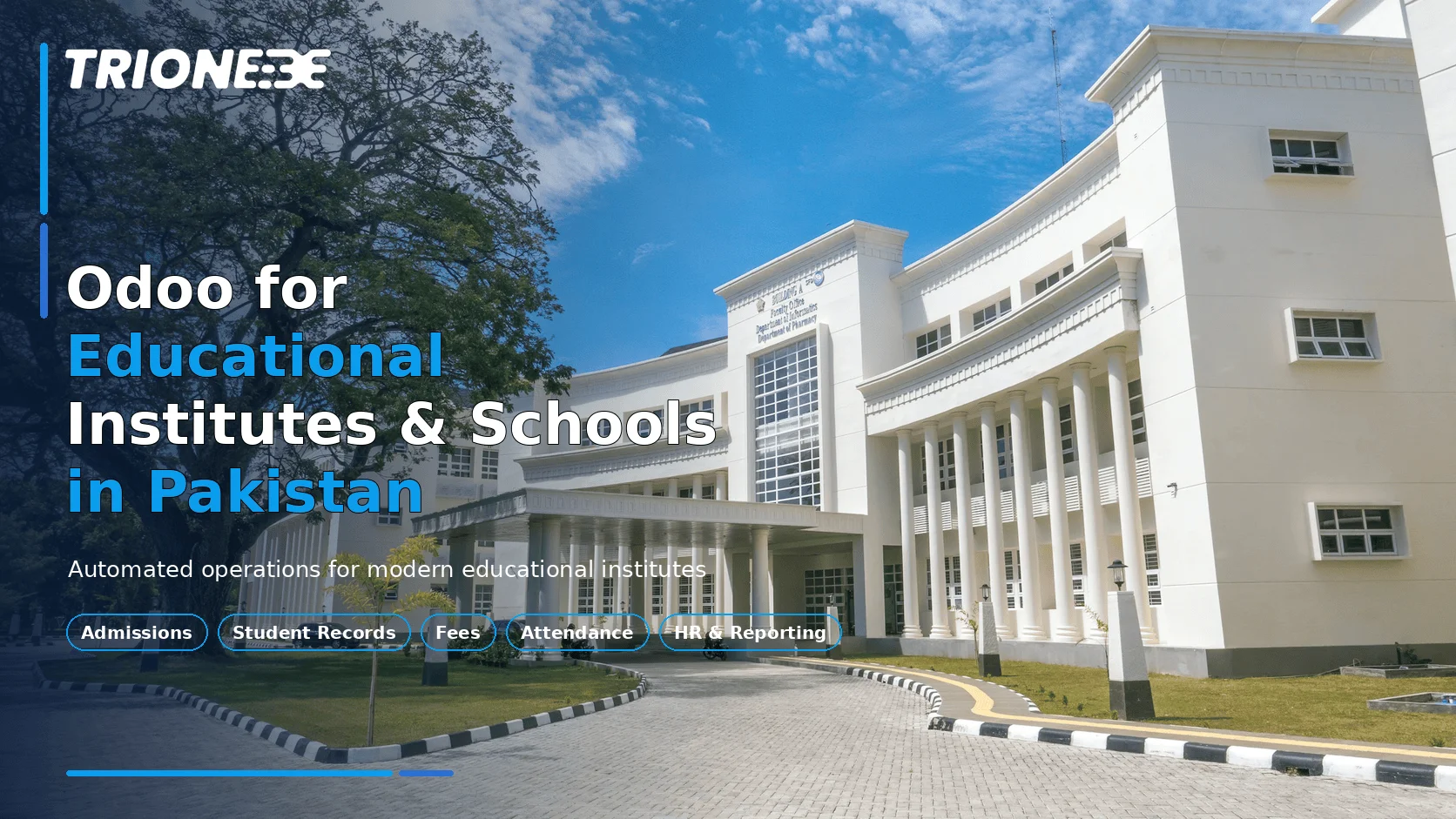
Educational institutions in Pakistan face an increasingly complex operational landscape. Managing thousands of student profiles, tracking fee payments, maintaining staff payroll with local tax compliance, and ensuring smooth communication with parents often requires significant administrative effort. When these functions run on disconnected legacy software, spreadsheets, or paper registers, operational inefficiencies inevitably multiply.
To maintain high educational standards and operational sustainability, progressive school leaders and business managers are moving toward integrated Enterprise Resource Planning (ERP) solutions. Odoo ERP has emerged as one of the most flexible, cost-effective, and comprehensive platforms available for digital transformation in the Pakistani education sector.
The Operational Challenges Facing Pakistani Educational Institutions
Before examining how Odoo solves operational hurdles, it is essential to understand the specific administrative pressures educational organizations encounter in Pakistan daily.
1. Fragmented Data and Disconnected Systems
Many schools utilize separate software tools for admissions, accounting, attendance, and report cards. Because these systems rarely communicate with one another, administrative teams waste hundreds of hours manually re-entering data. This fragmentation increases human error and prevents decision-makers from gaining a unified view of institution performance.
2. Complex Fee Structures and Financial Reconciliation
Managing tuition fees in Pakistan involves navigating intricate structures, including quarterly or monthly billing cycles, sibling discounts, scholarships, late payment fines, and advance tax deductions under local tax regulations (such as Section 236I of the Income Tax Ordinance). Tracking cash collections, bank transfers, and online payments across multiple branches without an automated system frequently leads to reconciliation discrepancies.
3. Manual HR and Payroll Processing
Educational institutes employ diverse workforce categories, including full-time teaching faculty, visiting lecturers, administrative personnel, and support staff. Calculating salaries, manage leaves, handling Provident Fund deductions, and processing tax withholding manually creates unnecessary burden for HR departments every month.
4. Communication Gaps with Parents and Guardians
Modern parents expect instant, transparent access to their child’s academic progress, attendance records, and fee status. Traditional communication channels like physical notes or unorganized messaging groups often result in missed announcements, delayed fee receipts, and customer dissatisfaction.
Why Odoo ERP is Well-Suited for Pakistani Schools and Colleges
Odoo is a modular, open-source enterprise suite designed to grow alongside your organization. Unlike rigid legacy software, Odoo provides a highly flexible platform that can be tailored to meet the specific administrative workflow of Pakistani schools while remaining accessible and user-friendly.
Modular and Scalable Architecture
Institutions do not need to overhaul their entire infrastructure overnight. With Odoo, a school can start by replacing its accounting and fee management system, and later expand into student admissions, HR, inventory, and online portals. As the institution opens new campuses, Odoo easily scales to support multi-branch operations from a centralized system.
Localization for Local Financial and Legal Requirements
Financial management in Pakistan requires strict adherence to local accounting standards and tax regulations. Odoo’s flexible accounting framework allows schools to configure sales tax, income tax withholdings, and specialized chart of accounts tailored to educational entities, ensuring smooth reporting and compliance with the Federal Board of Revenue (FBR).
Cost-Efficiency
Traditional enterprise software vendors charge heavy licensing fees per user or module, making digital transformation cost-prohibitive for many private schools. Odoo offers a transparent pricing structure that delivers enterprise-grade capabilities at a fraction of the cost of traditional competitors.
Core Odoo Capabilities for Educational Management
By bringing academic and operational functions under one roof, Odoo streamlines daily workflows for administrators, teachers, accountants, and parents.
1. Student Information & Admission Management
Odoo automates the entire student lifecycle, from initial inquiry to graduation. Educational institutions can capture online application forms, schedule entry tests or interviews, issue admission offers, and generate permanent student IDs automatically. All academic records, health forms, and historical documents are stored in a centralized, searchable database.
2. Automated Fee Billing & Accounting
Fee collection is the financial backbone of any private educational institute. Odoo’s invoicing engine allows administrators to set up automated recurring fee cycles. Key features include:
- Automatic calculation of tuition fees, lab fees, admission fees, and transport charges.
- Dynamic application of sibling discounts, financial aid, and merit scholarships.
- Generation of printable, standardized fee vouchers integrated with local banking channels and online payment gateways.
- Real-time tracking of outstanding dues and automated SMS or email reminders for parents.
3. Academic Management, Grading, & Attendance
Teachers can manage course schedules, track daily student attendance, and log academic marks directly through the system. Odoo implementation enables the creation of customized report cards based on institution-specific grading scales, reducing the burden on faculty during exam terms.
4. Human Resource Management & Payroll
Managing academic staff requires precise tracking of contracts, teaching hours, and leaves. Odoo HR automates salary generation based on attendance logs, handles complex tax formulas unique to Pakistan, manages leave approvals, and calculates payouts for hourly visiting faculty without error.
5. Campus Inventory, Transport, & Asset Management
Schools manage significant physical assets, including science laboratories, IT equipment, library books, and bus fleets. Odoo’s inventory and asset management modules allow administrators to track equipment distribution, schedule preventive maintenance, manage cafeteria sales through Point of Sale (POS), and optimize transport routes and fuel consumption.
A Practical Implementation Roadmap for Educational Institutions
Deploying an ERP system across an academic organization requires a deliberate strategy to minimize disruption during the active school year. Below is a structured implementation process recommended for schools in Pakistan.
Step 1: Requirement Discovery and Operational Audit
Identify pain points across departments—admissions, finance, academics, and administration. Document your current workflows, fee structures, and reporting needs before configuring the software.
Step 2: Solution Design and System Configuration
Map the institute’s requirements to Odoo’s native modules. Customize workflows where necessary, such as specialized fee voucher formats, grade books, or localized salary slips, while keeping core processes as standard as possible to ensure system stability.
Step 3: Data Migration and Cleaning
Extract existing data from legacy databases, spreadsheets, or paper archives. Clean and format student records, fee histories, staff files, and chart of accounts to ensure accurate data entry into Odoo.
Step 4: User Acceptance Testing (UAT) & Training
Conduct practical testing with key stakeholders, including accountants, administrative officers, and department heads. Comprehensive training ensures staff feel confident navigating the interface before full deployment.
Step 5: Phased Go-Live and Ongoing Support
Deploy the platform using a phased approach. For example, launch finance and HR during a term break, followed by academic and parent portal access. Continuous support ensures quick resolution of minor user queries.
Common Pitfalls to Avoid During ERP Adoption
While Odoo services offers powerful tools, implementation success depends heavily on execution. Watch out for these common missteps:
- Over-Customizing the Software: Attempting to replicate outdated, inefficient manual processes inside Odoo adds unnecessary complexity. It is often better to adjust operational workflows to align with established ERP best practices.
- Neglecting Data Verification: Uploading incomplete or inaccurate legacy student records into a new system leads to incorrect fee generation and reporting errors later.
- Inadequate Change Management: Administrative staff and teachers may resist moving away from familiar tools. Clear communication, hands-on training, and strong leadership backing are vital to driving system adoption.
- Choosing the Wrong Implementation Partner: Working with generic software developers who lack deep experience in Odoo configurations and local Pakistani business practices often leads to delayed projects and incomplete setups.
Frequently Asked Questions (FAQs)
1. Can Odoo handle multi-campus school networks in Pakistan?
Yes. Odoo natively supports multi-company and multi-branch architectures. Central management can review consolidated financial reports and overall enrollment metrics, while individual campus administrators only access data relevant to their specific branch.
2. How does Odoo integrate with local Pakistani bank payment channels?
Odoo can generate fee vouchers featuring unique payment identification numbers (such as 1Bill or Kuickpay formats) or export structured banking files. This allows parents to pay tuition fees online via mobile banking apps or ATM channels, with automatic bank reconciliation inside Odoo.
3. Is Odoo suitable for small private schools, or only large universities?
Odoo’s modular design makes it ideal for institutions of any size. Smaller schools can begin with essential modules like Accounting, Invoicing, and Student Records, adding advanced tools like Online Admissions or Portal Access as their operations grow.
4. Can parents access student report cards and fee status online?
Yes. Odoo provides a secure web-based portal where parents can log in to view attendance, academic progress, exam results, and pending or paid fee invoices directly from their computers or mobile devices.
Transform Your Educational Institution with Trionex
Modernizing school operations requires more than just installing software—it demands a clear operational strategy and an experienced technology partner. At Trionex, we specialize in delivering tailored Odoo implementations for businesses and educational institutes across Pakistan.
Our team works closely with your administrators, financial officers, and academic leaders to configure Odoo around your specific operational workflows. Whether you need to automate complex fee structures, digitize student admissions, or streamline staff payroll, Trionex provides the consultation, implementation, and ongoing technical support necessary to ensure a seamless transformation.
Contact Trionex today to discover how Odoo can streamline your administrative management and prepare your institution for long-term operational success.
Tagged with :