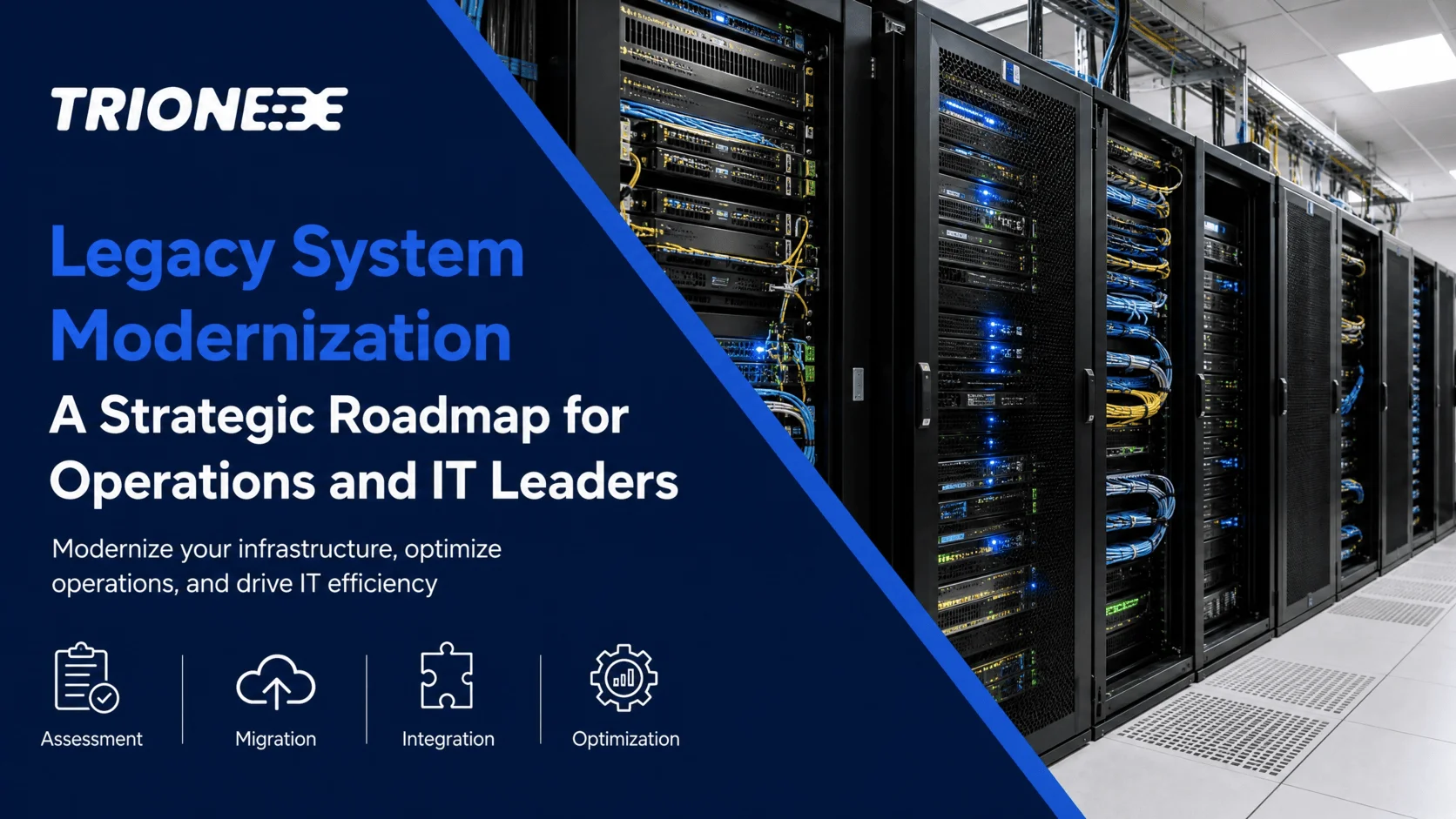
In many growing enterprises, core operations still rely on software built a decade or more ago. On one hand, these legacy systems have proven their reliability over time; they house critical business logic, hold years of historical data, and run workflows that staff know by heart. On the other hand, they increasingly act as silent growth killers. Operations teams face daily friction from slow performance, manual data re-entry, and lack of mobile access. Meanwhile, IT teams expend disproportionate time and budget maintaining outdated codebases, patching security vulnerabilities, and engineering makeshift integrations.
The dilemma for operations and technology leaders is clear: how do you modernize infrastructure that is too risky to keep, yet too vital to simply turn off? Modernization is not merely an IT infrastructure project; it is a fundamental business strategy. When executed correctly, modernizing legacy systems unleashes operational velocity, restores agility, and provides a clear foundation for future innovation. This guide outlines a actionable, low-risk roadmap for modernizing legacy software while maintaining business continuity.
What Is Legacy System Modernization (and What Is It Not)?
Legacy system modernization is the strategic process of transforming outdated enterprise software, architectures, and data structures into modern, agile cloud or hybrid environments. The primary goal is to unlock operational capability, enhance security, and reduce the total cost of ownership.
It is equally important to clarify what legacy modernization is not:
- It is not a mandatory “rip-and-replace” exercise: Complete software replacement is only one of several strategic pathways. Modernization can involve refactoring existing code, wrapping interfaces in modern APIs, or migrating core modules gradually.
- It is not just a visual redesign: Slapping a sleek user interface onto broken back-end architecture creates a cosmetic fix, not a modernized system. Real modernization solves systemic operational bottlenecks.
- It is not a pure IT initiative: Technology leaders cannot modernize in isolation. Without operational leadership defining real-world workflows, user adoption will fail.
The Seven Rs of Modernization Options
Technology leaders often reference Gartner’s framework for modernization options. Depending on your operational requirements, your roadmap will combine one or more of these strategies:
- Encapsulate: Leverage existing features by exposing data and logic through secure APIs.
- Rehost: Shift existing software components to cloud infrastructure without modifying code or functionality.
- Replatform: Migrate legacy applications to a new runtime platform with minimal code adjustments.
- Refactor: Restructure and optimize legacy code to remove technical debt and boost efficiency.
- Rearchitect: Alter application code significantly to transition to modern, modular, or microservices-based architectures.
- Replace: Retire old software completely and deploy a modern, scalable solution such as an integrated ERP or custom web application.
- Retain/Retire: Keep non-critical, stable systems in place until needed, or decommission redundant components entirely.
The Business Case: The Hidden Costs of Deferring Modernization
Delaying system modernization feels safe in the short term because it avoids immediate capital expenditure. However, legacy software carries a heavy hidden tax that compounds over time.
1. The Maintenance and Opportunity Drag
Outdated systems consume an estimated 60% to 80% of typical IT budgets just to keep the lights on. Every dollar spent maintaining deprecated databases, custom legacy integrations, and obsolete servers is a dollar lost to strategic business initiatives. Operationally, staff waste hundreds of hours manually aggregating reports across disconnected systems.
2. High Security and Compliance Vulnerabilities
Older applications often run on unsupported frameworks, obsolete operating systems, or weak security architectures. Patching these platforms becomes progressively harder, exposing organizations to cyber threats, data breaches, and non-compliance penalties.
3. Data Silos and Poor Decision-Making
When legacy tools cannot easily communicate with modern software, operational data becomes fragmented. Executives end up making critical strategic decisions based on outdated reports generated from offline spreadsheets rather than real-time operational analytics.
4. Talent Shortages and Risk Exposure
As senior engineers who built custom internal systems retire, finding qualified developers to maintain specialized, legacy platforms becomes difficult and expensive. Younger technical talent prefers working with modern software stacks, creating operational continuity risks for organizations tied to legacy technologies.
A 5-Phase Roadmap for Strategic System Modernization
To ensure alignment between operational needs and technical execution, organizations should follow a structured, phased modernization model.
Phase 1: Discovery, Assessment, and Technical Audit
Before writing a line of code or evaluating new software vendor platforms, establish an precise baseline of your enterprise architecture.
- System Inventory: Catalog every application, database, interface, manual process, and third-party integration currently in production.
- Operational Mapping: Interview department leads to map actual business processes against technical features. Document manual workarounds and persistent operational friction points.
- Technical Debt Assessment: Evaluate code quality, dependency health, system performance, security postures, and cloud readiness.
Phase 2: Target Architecture & Strategy Selection
Define your destination based on business priorities, scalability goals, and budget constraints. Determine whether your organization needs a specialized custom software build, a flexible modular ERP platform like Odoo, or a hybrid ecosystem combining cloud tools with refactored core applications.
- Focus on modularity, ensuring modern components communicate seamlessly through RESTful APIs or robust integration layers.
- Establish clear key performance indicators (KPIs) such as user onboarding speed, processing response time, system uptime, and transaction throughput.
Phase 3: Data Cleanse and Architecture Preparation
Migrating dirty, duplicated, or unstructured legacy data into a modern architecture ruins the value of modern software. Phase 3 focuses on operational data hygiene:
- Audit legacy databases to purge obsolete customer records, resolve duplicate entries, and standardize field formats.
- Establish security policies, access rules, and automated backup protocols for the target system.
- Construct temporary middleware or staging environments to allow smooth data synchronization during transition phases.
Phase 4: Iterative Execution and Migration
Avoid high-risk “big bang” cutovers whenever possible. Instead, deploy modern components in iterative, manageable releases.
- Pilot Migration: Choose a non-critical operational module or business unit to test the deployment pipeline, data transfer, and user adoption.
- Parallel Processing: For core financial or operational functions, run old and new platforms concurrently for a brief window to validate output accuracy.
- Decommissioning: Systematically phase out legacy hardware, modules, and licenses once the corresponding modern workflows are fully operational.
Phase 5: User Enablement & Continuous Optimization
Modernization succeeds only when end users embrace the platform. Technical completion does not equal business success.
- Provide practical, role-based training programs for operations staff rather than generic software walkthroughs.
- Establish a feedback loop between operational end users and technical teams to address usability concerns swiftly.
- Monitor post-implementation metrics to continuously fine-tune platform speed, automation workflows, and reporting accuracy.
Real-World Scenario: Replacing Disparate Tools with Integrated Enterprise Software
Consider a mid-sized distribution enterprise relying on a 15-year-old desktop inventory system paired with offline spreadsheets for purchasing and a standalone accounting package. Operational teams spent hours every day reconciling inventory counts, leading to stockouts, shipping delays, and delayed financial reporting.
Rather than attempting to patch the aging desktop software, leadership pursued a phased modernization strategy. They deployed a modern, open-source enterprise suite—utilizing Odoo’s modular framework for inventory, purchasing, and finance—while building custom API connectors to interface with specialized legacy shipping hardware.
The Operational Outcome: Order processing times dropped significantly, inventory visibility became real-time across all warehouses, and executive leadership gained access to automated consolidated financial dashboards.
5 Common Pitfalls to Avoid in Modernization Projects
Modernization initiatives often stumble due to predictable organizational mistakes. Avoid these common traps:
- Over-Customizing Modern Platforms: Forcing a modern ERP or software solution to mirror old, inefficient legacy processes negates the benefits of modernizing. Adapt your workflows to software best practices where appropriate.
- Neglecting Change Management: Employees resist software changes when they are not involved in the evaluation phase. Engage key operational super-users early in the project lifecycle.
- Underestimating Integration Needs: Modern tools rarely operate in complete isolation. Plan your API framework, third-party connectors, and middleware architectures from day one.
- Failing to Clean Historical Data: Transferring unstandardized historical data into modern system architectures creates performance degradation and reporting errors instantly.
- Lacking Executive Alignment: Ensure IT leaders and operational executives share common metrics for project success, budget allocations, and delivery milestones.
FAQs
1. How do we decide between custom software development and off-the-shelf ERP platforms?
Choose an off-the-shelf or modular ERP (such as Odoo) if your business workflows closely align with standard industry practices like accounting, standard inventory management, and CRM. Invest in custom software development when your core operational workflows serve as your primary competitive differentiator and cannot be accommodated by standard platforms without excessive customization.
2. How can operations teams minimize business interruption during system migration?
Minimize operational disruption by pursuing phased rollouts, deploying middleware to bridge old and new applications, and running brief parallel processing periods for critical business functions. Avoid high-risk cutovers during peak operational seasons.
3. What is the typical timeframe for a system modernization project?
Project timelines vary based on system complexity and scope. A targeted module replacement or cloud migration can take 3 to 6 months, whereas a comprehensive enterprise-wide ERP transformation typically spans 9 to 18 months, executed in distinct, value-delivering phases.
4. How do we measure the Return on Investment (ROI) of legacy modernization?
Calculate modernization ROI by evaluating both quantitative savings and qualitative gains. Quantifiable metrics include reduced software licensing fees, lower server maintenance costs, reduced manual labor hours, and faster order fulfillment cycles. Qualitative metrics include reduced compliance risk, enhanced data accuracy, and higher employee retention.
Building Your Modernization Strategy
Modernizing legacy software infrastructure is not about adopting the newest tech trends for their own sake—it is about positioning your enterprise for agility, scalability, and long-term competitiveness. By bridging the gap between operational demands and IT strategies, organizations can replace fragile, obsolete tools with robust, modern digital environments.
At Trionex, we partner with operational and technology leaders to turn complex modernization challenges into structured, high-value outcomes. Whether you are looking to streamline operations with modular Odoo ERP solutions, build custom enterprise software, or optimize legacy integrations, our team brings practical technical expertise and business acumen to your digital transformation journey. Connect with our strategic consultants today to audit your current system landscape and build a tailored modernization roadmap.
Tagged with :