A building project starts with a plan, yet its outcome depends on hundreds of connected decisions. Land records, supplier bills, labour costs, client commitments, approvals, rental income, and payment schedules all move at different speeds. When these records stay in separate files and systems, managers may see the financial impact only after the project margin has changed.
This is why many business owners search for Odoo for construction companies and real estate firms. They want one business platform that connects project costing, contracts, procurement, accounting, sales, inventory, and property operations. Odoo can provide that foundation through its modular ERP structure. The final setup should reflect the company’s projects, locations, reporting requirements, and local compliance needs.
Why construction and real estate need a connected operating system
Construction companies do not sell a simple product. They deliver a project through estimates, purchases, work orders, subcontractors, inspections, variations, and handover activities. A change in material rates or labour hours can affect the final margin.
Real estate companies follow a different operating cycle. Their activities may include land acquisition, development, sales, leasing, property maintenance, service charges, and collections. One company may manage completed units, properties under construction, rented spaces, and future developments at the same time.
Both industries need the same basic control. Each transaction should connect to the correct project, property, unit, client, contract, or cost centre. This gives management a clearer view of what was planned, what has been committed, what has been spent, and what is still due.
A practical view of Odoo ERP for construction
Odoo can be configured around the way a construction business works. A project can represent a building, road, housing scheme, commercial site, or renovation contract. Tasks can represent phases such as excavation, structure, electrical work, plumbing, finishing, and handover.
The Project application supports task planning and project level monitoring. Billable project records can also connect with revenue and cost information in the project profitability view. According to Odoo documentation, this view may include timesheets, purchase orders, materials, expenses, vendor bills, and other costs linked to the project’s analytic account .
This is useful because different teams ask different questions. A site manager may want to know which activities remain. A procurement officer may need to check an overdue delivery. A finance manager may be reviewing whether committed cost is still within the approved amount. A connected system gives every role access to the same underlying records.
Project costing from estimate to final account
Project costing is central to construction management. It should begin before work starts and continue until the final account is closed.
A project budget may include labour, materials, equipment, subcontractor charges, permits, transport, professional fees, and contingency. Each category can be assigned to an analytic account or analytic plan. Odoo’s analytic accounting tools are designed to track costs and revenue by project, department, or another business area .
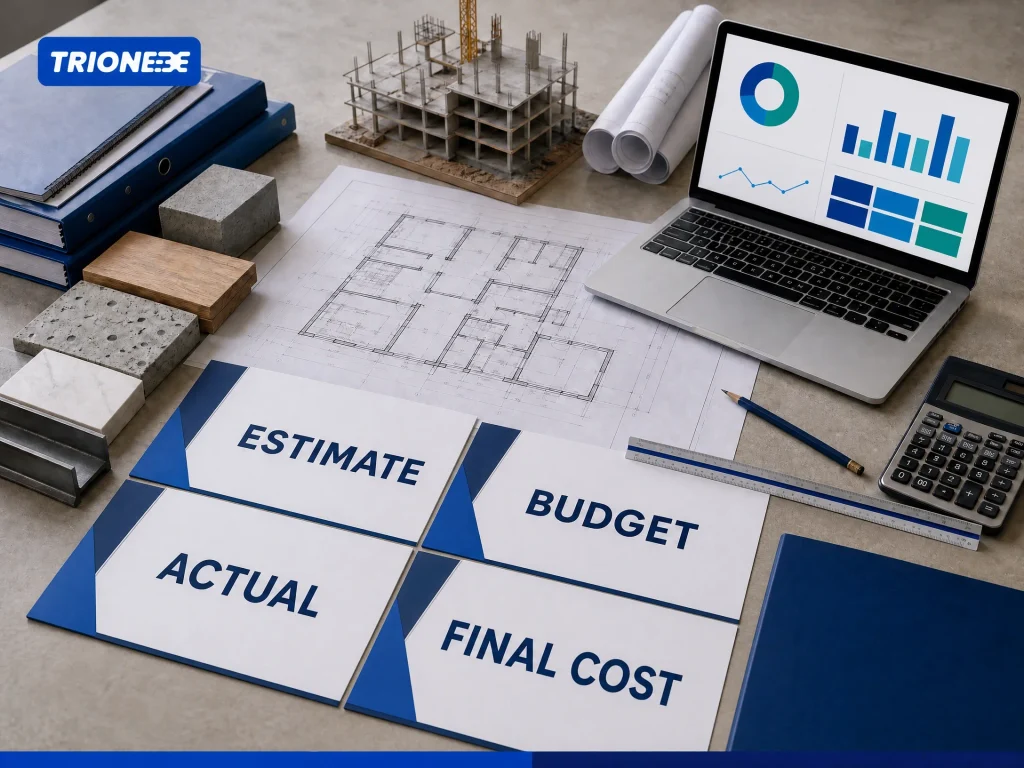
A construction company can organise its project costing cycle in the following way:
| Project costing stage | Information recorded in Odoo | Question answered |
| Initial estimate | Planned quantity, rate, labour, material, and service cost | What should this project cost? |
| Purchase planning | Requests for quotation, purchase orders, and supplier terms | What cost has been committed? |
| Site consumption | Delivered material, stock movement, equipment use, and expenses | What has reached or been used at the site? |
| Work progress | Timesheets, task completion, milestones, and variations | What work has been completed? |
| Billing | Customer invoices, retention, advances, and milestone claims | What can be billed and collected? |
| Final review | Actual cost, revenue, variance, and project margin | Did the project meet its financial plan? |
The value is not simply in having more figures. It comes from linking each figure to a project and its supporting document. A purchase order can be connected to the site that needs the material. A vendor bill can be reviewed against that order. A customer invoice can be linked to a milestone or agreed payment schedule.
Odoo analytic budgets can compare budgeted, committed, and achieved amounts. The official documentation notes that confirmed purchase orders that have not yet been billed can be reflected in the committed amount . This gives management a view of future pressure on the project budget, rather than only a record of past expenses.
Contracts are the control point for every project
Contracts define what a company has promised and what a client, supplier, or subcontractor must provide. They may cover scope, rates, milestones, payment terms, retention, penalties, variation rules, warranties, and completion conditions.
In Odoo, contract related records can connect with quotations, sales orders, purchase orders, invoices, documents, tasks, and activities. The design may differ by business. A contractor may need a client contract with milestone billing. A developer may need sales agreements for units. A property manager may need lease terms with recurring charges and renewal dates.
A contract workflow should answer five basic questions:
- Who is the responsible customer, supplier, owner, or tenant?
- What property, unit, site, or project does the contract concern?
- What amount is due and when is it due?
- Which documents prove that the agreed work or service was delivered?
- What action is required before renewal, completion, or expiry?
Odoo activities and reminders can help teams follow important dates. Documents can keep approvals and supporting files connected to the relevant record. This reduces the risk of relying on a personal inbox or an isolated spreadsheet for a critical obligation.
How Odoo supports real estate companies
A real estate business needs to track more than properties. It must understand the relationship between a property, unit, owner, tenant, broker, contract, payment, maintenance request, and financial account.
For a property developer, Odoo can bring land and development costs into project records. Units can be treated as products or structured records depending on the required level of detail. Sales teams can manage enquiries and reservations. Finance teams can manage invoices, advances, receivables, and payment follow ups.
For a rental business, Odoo Rental supports quotations, rental orders, scheduling, product pickup and return, and customer invoicing from one platform . A suitable real estate configuration can use these functions alongside accounting, CRM, documents, helpdesk, and maintenance. Custom fields or modules may be needed when the company manages complex unit structures, shared facilities, service charges, or local lease requirements.
A property management setup may cover the following activities:
| Real estate activity | Odoo area that may support it |
| Buyer or tenant enquiries | CRM and website forms |
| Unit availability | Sales, rental, inventory, or a custom property structure |
| Reservation and booking | Sales orders, deposits, and approval workflows |
| Lease or sale documentation | Documents and contract records |
| Recurring rent or instalments | Recurring invoicing and accounting |
| Maintenance requests | Helpdesk and maintenance |
| Vendor work | Purchase and vendor bills |
| Owner and management reporting | Accounting and analytic reporting |
This approach helps a company view property operations as one connected business process. It also makes it easier to identify where a custom workflow is necessary instead of adding complexity to every area.
Procurement and inventory at the site level
Material control is a major concern for construction firms. Materials may be bought centrally, received at a warehouse, transferred to a site, consumed during work, or returned after a phase is complete. Without clear records, the company may pay for urgent purchases while usable stock remains elsewhere.
Odoo Inventory and Purchase can be configured to track products, suppliers, receipts, internal transfers, delivery orders, and stock valuation. Site locations can be represented through warehouses or stock locations. Reordering rules can support items with predictable demand. Approval rules can be introduced for purchases above a defined value.
The process should reflect the company’s actual movement of goods. A typical sequence may start with a request from the site. The project manager approves it. The procurement team buys from an approved supplier. The warehouse receives the material. The stock moves to the site. The item is then issued to the relevant project. The accounting entry and project costing record should follow the same chain.
A construction company that imports fittings, machinery, tiles, or other materials may also need customs and landed cost records. In that case, the internal guide on Odoo for import export can help teams consider the relationship between purchasing, currency, customs, and inventory valuation.
Accounting and cash flow for long projects
Construction and real estate projects can remain open for months or years. Cash may be received in stages, while costs are incurred before the related customer payment arrives. This makes receivables, payables, retention, advances, and cash forecasts important management areas.
Odoo Accounting can connect invoices, bills, payments, bank transactions, taxes, and analytic reporting. A project or property structure can give management a clearer view of revenue and cost by site, development, unit, or business line. The accounting design should be agreed with the finance team because treatment can vary according to contract terms and local reporting rules.
The system should make it easy to review three views of the same project. The first is the commercial view, which shows the contract value and expected billing. The second is the operational view, which shows progress, purchases, and resources. The third is the financial view, which shows invoices, collections, bills, and margin.
These views become more useful when the company defines its chart of accounts, analytic plans, approval rules, project stages, and reporting calendar before configuration begins.
The Odoo modules that may matter most
There is no single Odoo setup for every company in construction and real estate. A small contractor may begin with CRM, Sales, Purchase, Inventory, Accounting, and Project. A property developer may add Website, Documents, Sign, Helpdesk, and Rental. A larger group may need multi company accounting, payroll, field operations, custom reporting, and integrations.
The selection should follow business processes rather than a long list of applications. Trionex’s Odoo modules list can serve as a starting point for reviewing the wider Odoo ecosystem.
A needs assessment can classify each requirement as standard, configurable, custom, or integration based. This keeps the initial scope practical and makes future phases easier to manage.
What a sensible implementation looks like
An ERP project is more than installing applications. It involves decisions about data, responsibilities, approvals, reporting, and user adoption. Construction and real estate companies should first map their current process from enquiry to contract, purchase to delivery, progress to billing, and payment to reconciliation.
The next step is to define master data. This may include projects, sites, properties, units, customers, suppliers, products, employees, subcontractors, contract types, cost codes, and tax settings. Clean master data is necessary for reliable reporting.
A sensible rollout often starts with a pilot project or one business unit. The team can test costing, procurement, contract billing, document control, and financial reports using real examples. After the pilot is accepted, the company can extend the system to more projects, sites, and entities.
Trionex provides Odoo services for process analysis, configuration, custom development, training, and post launch support. Its Odoo implementation service can help turn these steps into a controlled rollout. The right partner should also explain which requirements can be handled through standard Odoo and which ones need a controlled change.
Common mistakes to avoid
A construction or real estate ERP project can face problems when the company begins with screens instead of processes. Selecting modules without defining the information flow may create duplicate records and unclear ownership.
Another issue is treating project costing as a finance only task. Cost codes, purchase categories, site locations, and timesheet rules affect both operations and accounts. Project managers, procurement staff, sales teams, and finance users should agree on the structure together.
Companies should also avoid creating a custom feature for every preference. Custom development has a place when a requirement is central to the business or required for compliance. Standard workflows are often easier to maintain when they already match the need.
Finally, reporting should be tested before launch. If a director wants profit by site, a finance manager wants committed cost, and a project manager wants material consumption, those reports should be designed and validated early.
Is Odoo suitable for your construction or real estate business?
Odoo can be a strong option when a company wants its commercial, operational, and financial records to work together. It is especially useful for businesses moving beyond spreadsheets while still needing a system that can accommodate their own processes.
The best fit depends on project volume, contract types, number of companies, property structure, reporting needs, and the level of customisation required. A contractor with ten active sites may need a different design from a developer managing thousands of units or a property manager handling recurring leases.
Before choosing the final setup, document the process, define the reports, confirm the accounting treatment, and identify the records that must be connected. This creates a clear foundation for an Odoo system that supports daily work and long term control.
Final thoughts
For construction and real estate companies, Odoo ERP is most valuable when it connects the full commercial story of a project. From the first enquiry to the signed contract, from the approved purchase to the delivered material, and from work progress to the final payment, each step can contribute to a clearer business record.
Trionex helps companies plan, configure, customise, and support Odoo solutions for their operational needs. Visit trionex.pk to learn more about its Odoo and enterprise services.
Tagged with :