Import-export businesses run on thin margins and tight timelines. A shipment crosses borders, passes through customs, and changes currency more than once before it ever reaches a customer. When these moving parts sit in separate spreadsheets and disconnected tools, small errors turn into real financial losses. Odoo for import export businesses brings currency handling, landed cost, and customs compliance into one connected system, built to match how trading actually works.
What problems do import-export businesses face without an ERP?
Most trading businesses run into the same set of problems once shipment volume grows past a handful of orders a month.
- Currency exposure: purchases happen in US dollars or another foreign currency, but exchange rates move between the order date and the payment date, and spreadsheets rarely catch the difference in real time
- Inaccurate landed cost: freight, insurance, customs duty, and clearing charges get added after the goods already sit in stock, so the recorded cost is wrong from day one
- Customs paperwork errors: a Goods Declaration filed with the wrong product classification or missing documents causes delays at clearance
- Missed compliance deadlines: letters of credit, import permits, and export licenses all carry hard dates, and a missed deadline can mean lost payment or a compliance breach
- Disconnected tools: many businesses run QuickBooks for accounting, a spreadsheet for shipment tracking, and WhatsApp for supplier communication, with nobody having one full picture
None of these problems come from a lack of effort. They come from tools that were never built to handle international trade in the first place.
How does Odoo solve currency and landed cost problems?
Odoo records every purchase in its original currency and automatically revalues it as exchange rates shift, so the actual gain or loss shows up in your accounts as it happens, not months later during a reconciliation. On the cost side, Odoo lets you allocate freight, insurance, customs duty, and clearing charges directly onto the purchase order. The true landed cost then flows straight into your stock valuation, so your pricing decisions rest on real numbers instead of a rough estimate corrected after the fact.
How does Odoo simplify customs clearance in Pakistan?
Every shipment entering or leaving the country goes through WeBOC, Pakistan Customs’ clearance system, or the Pakistan Single Window that connects it to other regulatory bodies. A Goods Declaration needs accurate product classification, including HS codes, before customs will process it. When your product records already carry the correct classification and supporting documents inside Odoo, filing that declaration becomes routine paperwork instead of a scramble every time a container arrives at port.
This is the exact setup Trionex built for Honda Lahore, a business that imports at real volume and cannot afford customs delays holding up delivery schedules.
How does Odoo prevent missed compliance deadlines?
A letter of credit has a presentation deadline, and missing it can mean payment falls through entirely. An import permit or export license has a renewal date, and letting it lapse creates a compliance breach, not just paperwork. A properly planned Odoo implementation ties these dates to scheduled activities on the actual shipment or contract record, so a deadline shows up as a task on someone’s desk well before it becomes urgent, instead of living only in an inbox or a spreadsheet that goes stale.
Can Odoo support wholesale and retail sales alongside trading?
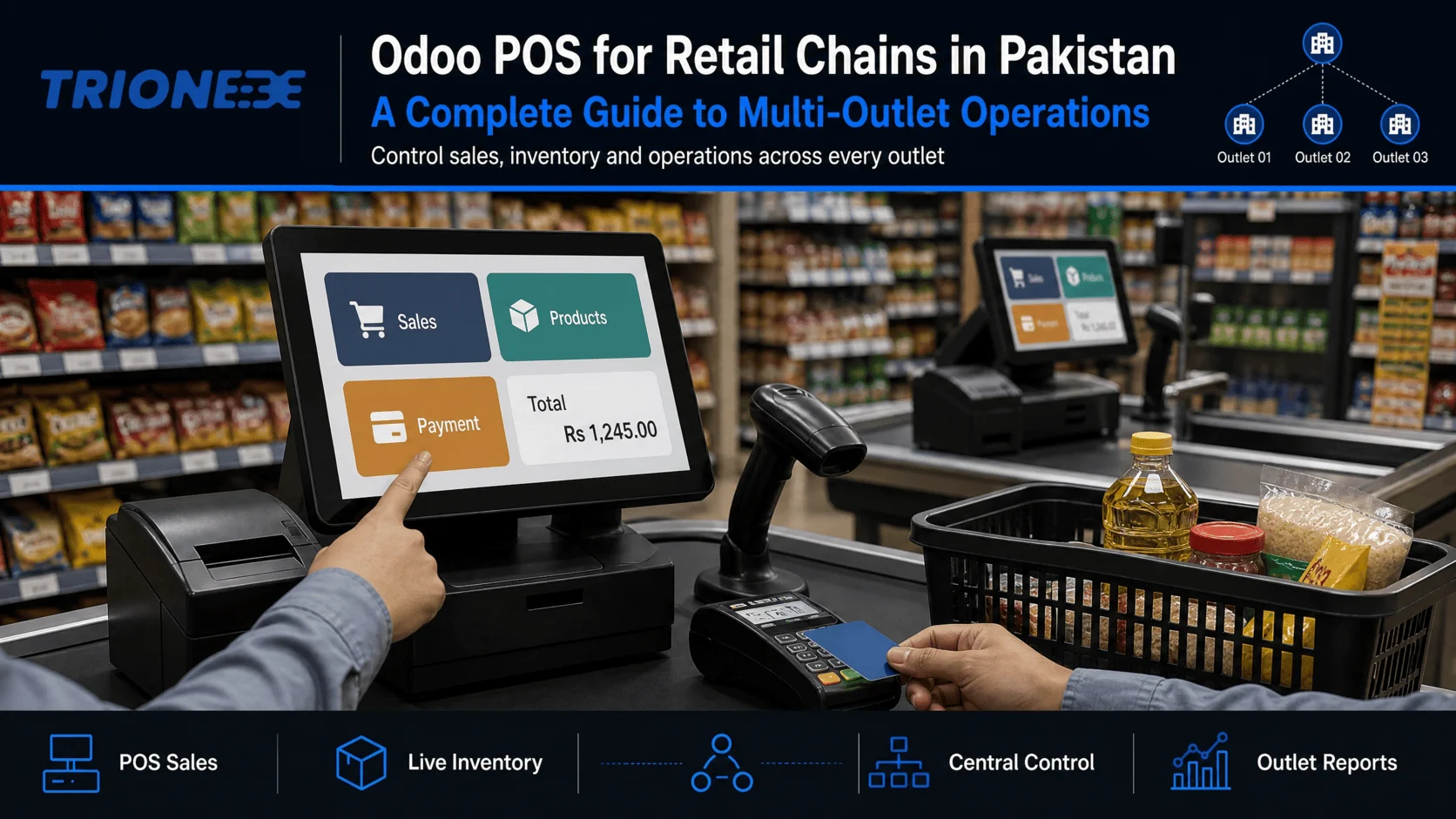
Many trading companies do not stop at bulk sales. Stock that clears customs often moves two ways: some of it goes out to other businesses at wholesale pricing, which our guide to Odoo for wholesale distributors covers in detail, and some of it sells directly through a showroom or retail counter. That counter needs to draw from the same stock as the rest of the business, which is exactly what Odoo POS does when it runs on shared inventory instead of its own disconnected till.
Who should set up Odoo for a trading business?
Currency handling, landed cost rules, and customs documentation are not settings a generic ERP rollout gets right by default. This needs someone who has configured trade-specific operations before. Working with established Odoo partners in Pakistan, people who already know where trading businesses get stuck, makes the difference between a system that works from day one and one that needs constant fixing.
Frequently asked questions
Does Odoo handle HS code classification for customs filing?
Yes. Product records carry HS codes and classification details directly, so the information needed for a Goods Declaration is already attached before a shipment arrives.
What does an Odoo setup cost for a trading company?
It depends on your currencies, warehouses, and compliance needs. Our Odoo cost guide explains what actually drives that number up or down.
Is Odoo only worth it for large trading operations?
No. A smaller business can start with Purchase, Inventory, and Accounting connected, then add landed cost rules and document tracking as shipment volume grows.
Will switching from spreadsheets disrupt current shipments?
Not if it is planned properly. Supplier records and past transactions import directly, and running both systems briefly in parallel confirms nothing gets lost during the switch.
Can one system handle both import and export operations together?
Yes. The same purchase, sales, inventory, and accounting apps handle both directions, so a business importing raw material and exporting finished goods does not need two separate systems.
The bottom line for trading businesses
Every problem covered here, currency risk, inaccurate cost, customs delays, missed deadlines, comes from running international trade on tools that were not built for it. Odoo closes that gap by keeping currency, cost, and compliance inside one connected system. If your trading business is still managing these risks by hand, Trionex can walk through what a properly configured setup would look like for your shipments.
Tagged with :