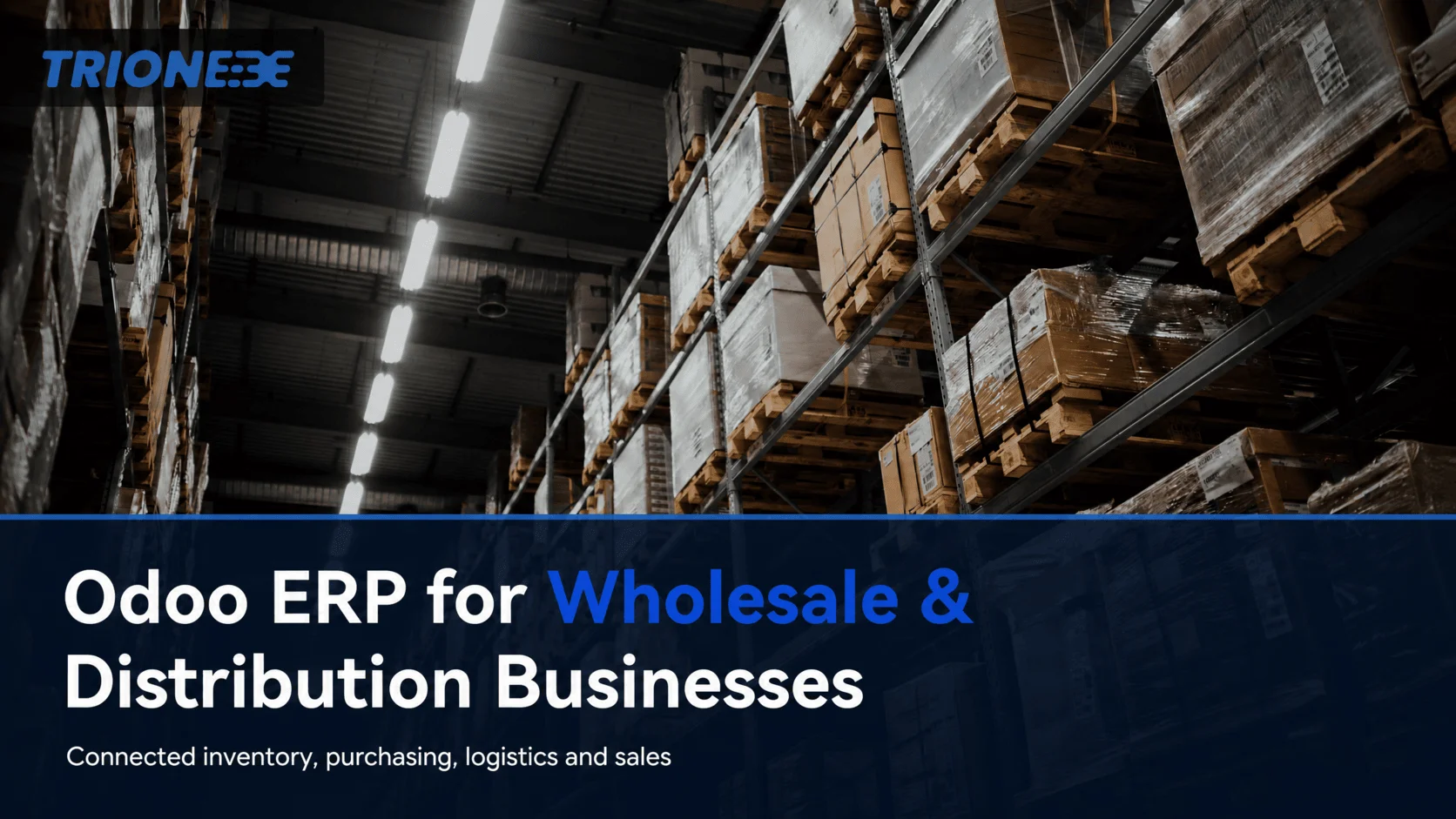
A wholesale business does not make anything. It moves large volumes of goods from suppliers to other businesses, fast and at thin margins. That single fact changes what a system needs to do well. You need speed on order intake, tight control on stock across warehouses, and pricing that adjusts by customer, not one fixed price list. Odoo for wholesale business handles all three in one connected system instead of forcing you to juggle separate tools.
How a wholesale order actually moves
Picture a typical order. A customer places it, either through a sales rep, a phone call, or an online B2B portal. The system checks stock across every warehouse instantly. It also checks that customer’s credit limit before confirming the order, so you don’t ship goods to someone who already owes you money. Once confirmed, the warehouse team picks and packs against a clear list, and the invoice generates automatically the moment goods leave the building. This single order actually touches several connected apps behind the scenes, sales, inventory, and accounting, and our Odoo modules list breaks down what each one handles. Nobody re-types the same order into three different spreadsheets along the way.
Pricing gets complicated fast
Wholesale pricing rarely stays simple. Different customers pay different rates. Buy more, pay less per unit. Some customers lock in contract pricing for months. Others only qualify for a discount once they cross a certain order size. Fabric and garment wholesalers deal with an extra layer here, pricing that shifts by meter, by roll, or by weight depending on the buyer, which our guide to Odoo for textile industries covers in more detail. Odoo lets you set these rules once, tied to each customer or customer group, and the system applies the right price automatically at checkout. Nobody on your sales team needs to remember which of your fifty customers gets which rate.
Selling to thousands of small shops
Here’s where Pakistani wholesale distribution looks different from the generic playbook most ERP guides describe. A huge share of distribution in this country runs through sales reps visiting kiryana stores directly, sometimes from a van stocked with product, collecting orders and cash on the same trip. This is a different world from a single storefront, which our guide to Odoo for retail businesses covers separately, since a distributor is selling to other businesses, not walk-in customers. This model needs route planning, order-taking on a mobile device while standing in the shop, and same-day reconciliation of what left the van against what came back in cash. Odoo can run this entire loop, from the rep’s order entry to stock deduction to the day’s cash reconciliation, instead of leaving it to a notebook that someone reconciles two days late.
Landed cost on imported stock
Many wholesale businesses in Pakistan import goods rather than buy locally, whether that’s electronics, cosmetics, or hardware. The real cost of an imported item is never just the supplier’s invoice price. Customs duty, freight, and clearing charges all add to it, and if you don’t track that properly, your margins look better on paper than they actually are. Some distributors go a step further and repack or lightly assemble imported goods before selling them on, which starts to overlap with what we cover in our guide to Odoo for manufacturing businesses. Odoo lets you add these landed costs to a purchase order so the true cost per unit flows straight into your stock valuation and your pricing decisions, not a separate spreadsheet calculation done after the fact.
Keeping multiple warehouses honest
Most distributors run more than one warehouse, sometimes in different cities. Stock needs to move between them without losing visibility, and someone at head office needs a real answer to “how much do we actually have” without calling three warehouse managers. Odoo tracks stock in real time across every location, including batch and serial numbers for products that need it, like anything with an expiry date. Odoo also tracks backorders properly, so a partial shipment doesn’t quietly become a forgotten one.
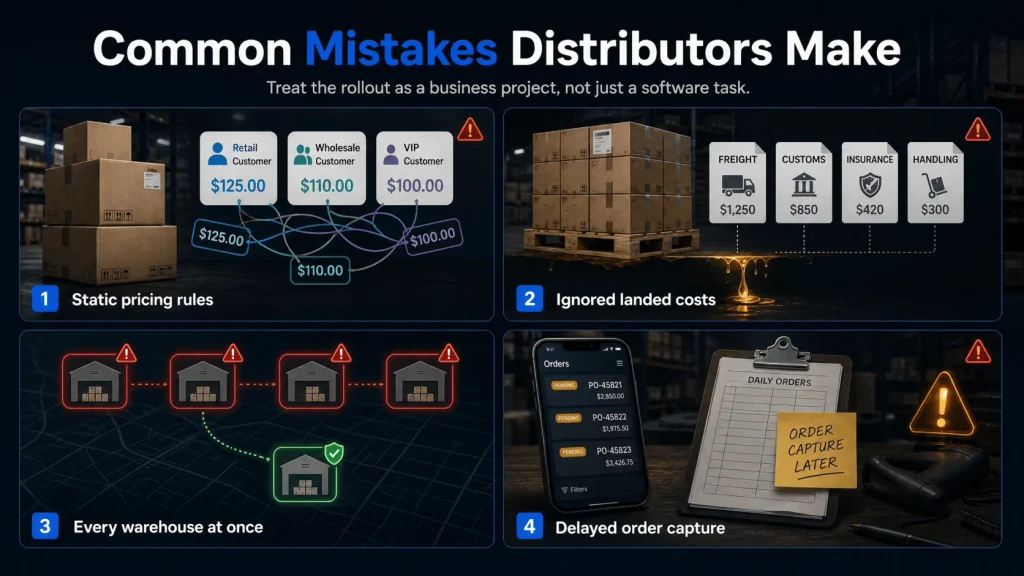
Common mistakes distributors make
Most of these mistakes come from treating the rollout as a software task instead of a business one. Working with established Odoo partners in Pakistan who already understand distribution helps you avoid them from the start.
- Setting up pricing rules as static price lists instead of using customer-based rules, which becomes a maintenance headache within months
- Ignoring landed cost tracking, which quietly erodes margins nobody notices until year-end
- Rolling out every warehouse at once instead of stabilizing one location first
- Treating sales rep order-taking as a future upgrade instead of part of the initial setup, when it is often the biggest daily pain point
Getting the setup right
A wholesale rollout is not just software installation. It needs someone who has actually configured distribution businesses before, not a generic template applied to your operation. This is exactly the kind of work an experienced Odoo implementation partner handles from day one, mapping your actual order flow before touching any configuration screen.
Frequently asked questions
Does Odoo support FBR e-invoicing for wholesale businesses? Yes. Odoo’s accounting can be configured to generate FBR-compliant digital invoices directly at the point of sale, which matters for distributors issuing large volumes of invoices daily.
How much does Odoo cost for a wholesale or distribution business? It depends on which apps you need and how many users will access the system. Our Odoo cost guide breaks down what actually drives the price up or down.
Can I switch from Excel or manual registers to Odoo without losing my records? Yes. Customer lists, past orders, supplier details, and stock counts can all be imported, and most implementations run a trial period alongside the old system before fully switching over.
Is Odoo too complex for a small distribution business just starting out? No. You can start with just order management and inventory, then add pricing rules, route sales, or landed cost tracking once the business actually needs them.
Does Odoo handle multi-currency for businesses that import stock in US dollars? Yes. You can record purchases in the supplier’s currency while your books stay in Pakistani rupees, with exchange rate differences tracked automatically instead of calculated by hand.
What this means for your business
Wholesale margins are thin, and every manual step eats into them somewhere. Odoo removes the guesswork between order intake, warehouse stock, and pricing, replacing scattered spreadsheets with one live system. Trionex is an Odoo Silver Partner based in Lahore, working with businesses across manufacturing, retail, and trading. If your distribution business is still juggling separate tools for orders, stock, and pricing, we can walk through what a connected setup would actually look like for you.
Tagged with :