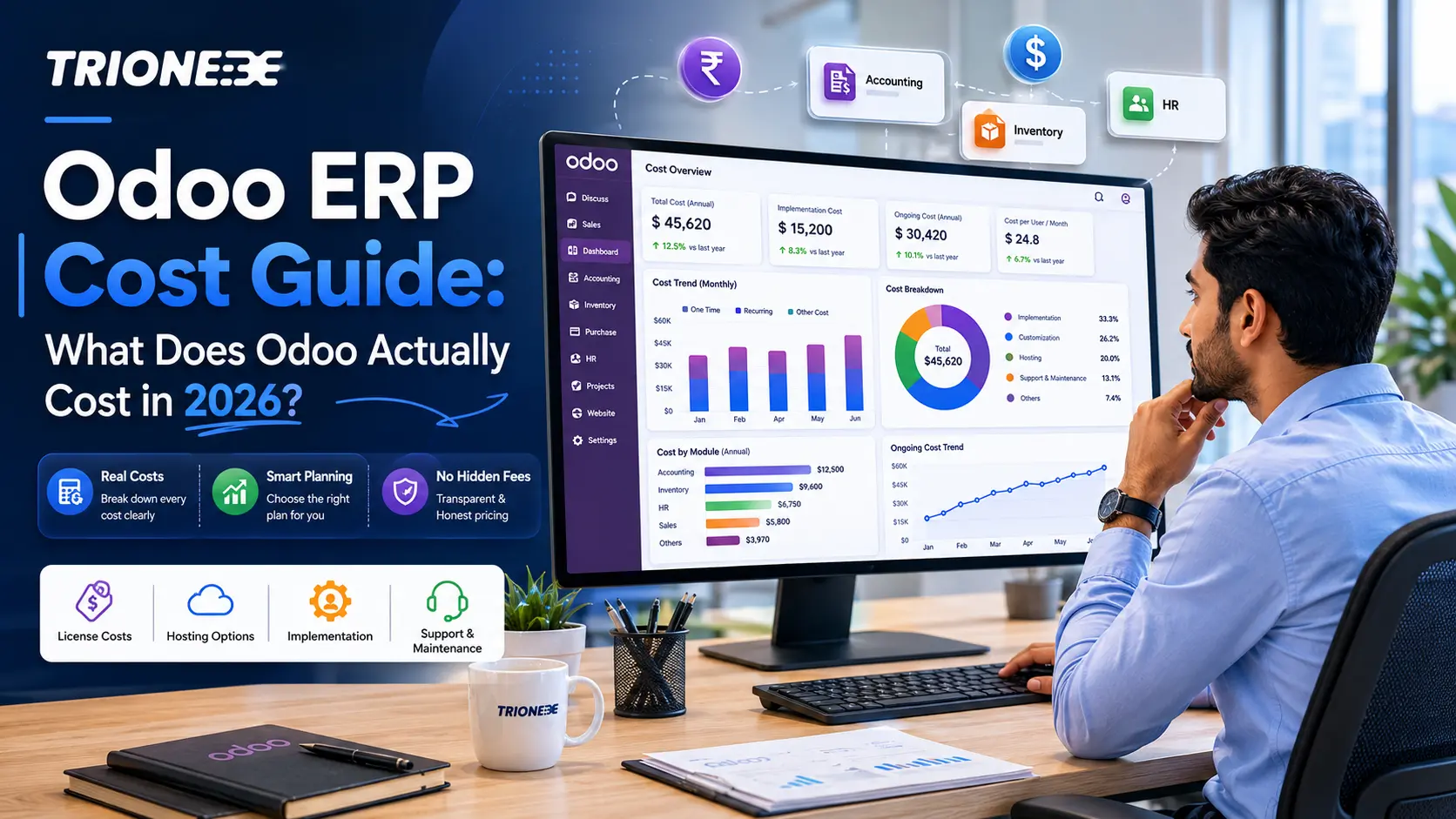
When businesses start evaluating Odoo, the first question is always: how much will this actually cost? It is a fair question, and the honest answer is that there is no single number — because Odoo ERP cost is not just one thing. It is the sum of licensing, implementation services, customization, data migration, training, hosting, and ongoing support. Each of these layers adds up differently depending on your business size, the modules you need, and the implementation partner you choose.
What makes Odoo genuinely stand apart from other ERP platforms is not that it is cheap — it is that it is transparent. No per-module licensing fees, no hidden transaction caps, no surprise charges for adding functionality. The cost model is straightforward once you understand its structure.
This guide breaks every layer down so you can build a realistic budget before you speak to a single vendor.
1. Odoo Licensing Cost: Your Starting Point
Odoo offers three tiers, and the right one depends on how much flexibility your business needs.
One App Free
Odoo’s free tier allows unlimited users on a single application at no cost — hosted on Odoo Online. If your only requirement is CRM, or Invoicing, or Project Management as a standalone tool, this is genuinely free to use indefinitely. Applications that depend on the chosen app are also included at no charge. For micro-businesses or companies testing the water before committing, this is a useful entry point.
Odoo Standard
The Standard plan provides access to all core Odoo applications hosted on Odoo Online. Pricing runs at approximately $24.90 per user per month on an annual contract. This plan suits businesses with standard workflows that do not require code-level customizations or community modules. The hosted environment is managed entirely by Odoo — no infrastructure to worry about.
Odoo Custom (Enterprise)
The Custom plan is what most growing businesses and mid-sized companies actually need. It includes all applications, supports custom module development, third-party integrations, and flexible hosting — either on Odoo.sh, your own server, or a cloud provider like AWS or Azure. Pricing starts at approximately $37.40 per user per month in the first year, depending on region, contract term, and current Odoo pricing. This is the plan relevant to any business that needs Odoo services to adapt to its workflows rather than the other way around.
One important structural advantage: Odoo charges per user, not per module. Adding Sales, Inventory, Manufacturing, Accounting, and HR to the same instance does not increase your Odoo monthly cost beyond the per-user rate. That flat model makes budgeting far more predictable than legacy ERP systems that charge per module or per transaction volume.
| User Count | Annual License (USD) | Approx. Annual (PKR) |
| 5 users | ~$2,244 | ~PKR 625,290 |
| 10 users | ~$4,488 | ~PKR 1,250,581 |
| 25 users | ~$11,220 | ~PKR 3,126,453 |
| 50 users | ~$22,440 | ~PKR 6,252,906 |
| 100 users | ~$44,880 | ~PKR 1,250,5812 |
2. Hosting Options and Their Cost Impact
Your choice of hosting affects both your monthly running cost and the level of customization available to your business.
Odoo Online (SaaS): Managed entirely by Odoo. Hosting is included within the subscription cost. No infrastructure management required. The trade-off is that code customizations are not possible — you work within Odoo’s standard feature set. Best for small businesses with straightforward needs.
Odoo.sh (Managed Cloud): Odoo’s own platform-as-a-service, designed for businesses that need customization flexibility without managing their own server. Odoo.sh includes staging environments, GitHub integration, automated backups, and one-click deployments. This is an additional cost on top of user licensing — typically $60 to $120 per month depending on the selected plan. Worth it for any business doing active development.
On-Premise / Self-Hosted: Businesses host Odoo on their own servers or a cloud provider (AWS, Google Cloud, Azure). No additional hosting fee to Odoo, but the business is responsible for server setup, security patches, backups, and system administration. The Community Edition can be hosted this way with no licensing cost at all, though it lacks some Enterprise features.
3. Implementation Cost: The Largest Variable
If licensing is the predictable part of your Odoo ERP cost, implementation is where the real variation lives. Industry benchmarks consistently show implementation services represent 40 to 60 percent of total first-year spend.
What goes into implementation? Business process analysis and requirements mapping, system configuration, user acceptance testing, go-live support, and post-launch stabilization. For most projects, this is the work your Odoo implementation partner handles.
The scope of what needs to be configured directly determines cost. A business deploying three modules for 15 users with clean existing data will have a very different implementation experience than a manufacturer deploying eight modules, integrating with a third-party logistics platform, and migrating five years of legacy ERP data.
| Project Profile | Typical Scope | Estimated Cost Range (USD) |
| Small Business | 3–4 modules, 5–15 users, minimal custom | $5,000 – $15,000 |
| Mid-Size Business | 6–8 modules, 15–50 users, some customization | $15,000 – $50,000 |
| Complex / Manufacturing | 8+ modules, integrations, heavy custom | $50,000 – $120,000+ |
4. Odoo Customization Cost
Standard Odoo covers the majority of common business processes out of the box. But most businesses have workflows that are specific to their industry, their team structure, or their operational history — and adapting Odoo to those workflows requires customization.
Odoo customization happens at different levels. At the lightest end, Odoo Studio lets non-technical users add fields, redesign forms, and build automated workflows — no coding required, and it is included in the Custom plan. At the deeper end, custom Python modules extend or override core system behavior for industry-specific requirements.
Customization is typically billed at an hourly rate by your Odoo implementation partner. Minor workflow adjustments may take a few hours. A fully custom module for a specific industry process — say, garment cutting and stitching workflow management, or a batch production tracking system for food manufacturing — can take weeks of development time.
The important caution here is over-customization. Every custom line of code is something that needs to be maintained and potentially re-tested with each Odoo version upgrade. Good Odoo consulting practice means evaluating whether a business need genuinely requires custom code, or whether it can be met through smart configuration of existing features.
5. Data Migration Cost
Data migration is the cost that catches businesses by surprise most often. Moving your existing data — customers, vendors, products, inventory balances, open invoices, historical transactions — from a legacy system or even from spreadsheets into Odoo is rarely as simple as an import.
The complexity and therefore the cost of data migration depends on: the volume of records to be migrated, the quality and structure of existing data, whether historical transaction data or only opening balances are needed, and the number of source systems being consolidated.
A clean migration from one well-structured system into Odoo may take a few days of work. A messy migration pulling data from multiple sources — a combination of QuickBooks, Excel, and a custom invoicing system — can take weeks and require significant data cleansing effort before a single record can be imported.
Underestimating this is one of the most common reasons ERP budgets overrun. The fix is a proper data audit before the project starts, not during go-live week.
6. Training Cost
An ERP system only delivers value when the people using it actually know how to use it properly. Training is often the most underbudgeted line item in any implementation.
Odoo offers its own e-learning platform with official training courses, and the documentation is extensive. For many standard use cases, self-paced learning supplemented by partner-led sessions during implementation is sufficient. For complex roles — warehouse managers, accountants, procurement officers — structured training sessions are worth the investment.
The cost of training scales with team size and the complexity of the modules being deployed. Budget for role-based training sessions, user acceptance testing time (where staff validate the system before go-live), and post-launch support queries. A well-run Odoo support and maintenance arrangement should also include access to ongoing training for new staff.
7. Ongoing Costs: The 3-Year View
The discussion of Odoo cost usually focuses on year one. But understanding the three-year total cost of ownership is what gives you a genuine picture of the investment.
After go-live, the recurring costs to plan for are:
- Annual licensing renewal (same per-user rate, adjusted for team growth)
- Hosting fees if on Odoo.sh or a third-party server
- Annual support and maintenance contract — typically 15 to 20 percent of implementation cost per year
- Version upgrades: Odoo releases a new version annually; major upgrades from one version to the next require planning, testing, and sometimes code updates for custom modules
- New module additions as the business grows
- Additional customization or integrations as requirements evolve
A useful rule of thumb from ERP implementation practice: budget 1 to 2 percent of annual revenue for your total ERP investment in year one. This is the guideline cited by multiple industry bodies for right-sizing an ERP budget relative to business scale. A company with PKR 100 million in annual revenue should expect to invest PKR 1 to 2 million in year one — which aligns well with what a proper Odoo implementation looks like for a company of that size in Pakistan.
8. The Hidden Costs Nobody Talks About
Even with a clean budget, businesses consistently underestimate a few costs that do not appear on any vendor quote.
Internal team time: ERP implementation is not something a partner does to your business — it is something done with your business. Department heads, finance staff, IT managers, and operations leads all spend significant hours in requirements sessions, UAT, and training during the project. That time has a cost, even if it does not appear on an invoice.
Business process reengineering: Implementing an ERP is the right moment to fix broken processes — but fixing broken processes takes time and generates internal resistance. Change management is a real cost, and projects that ignore it have higher rates of low adoption and rework.
Temporary productivity dips: The first four to eight weeks after go-live are almost always slower than normal. Staff are learning, processes are being refined, and the team is building confidence in the new system. Planning for this avoids mistaking a normal transition period for a system failure.
Over-customization rework: Businesses that customize heavily during implementation sometimes discover that their customizations conflict with standard Odoo upgrades or create maintenance burdens. Investing in good Odoo consulting upfront — to validate whether customization is actually needed — pays for itself in avoided rework.
9. How to Control Your Odoo ERP Budget
The businesses that get the best outcome from an Odoo implementation are the ones that approach it with clear scope, the right partner, and realistic expectations. A few practical principles:
- Start with the modules you genuinely need, not every module Odoo offers. You can always add Odoo modules later — and the modular architecture makes that straightforward.
- Invest in a proper discovery and scoping phase before signing an implementation contract. A week of requirements analysis at the start saves months of rework later.
- Separate what needs to be customized from what can be configured. Configuration is cheaper, faster, and easier to maintain than custom code.
- Choose a certified Odoo implementation partner with documented experience in your industry. The cost of a bad implementation far exceeds any savings from choosing the cheapest option.
- Plan your Odoo integration requirements early. Connecting Odoo to existing systems — payment gateways, logistics APIs, eCommerce platforms, bank feeds — is easier when designed upfront than retrofitted after go-live.
- Budget for post-launch support from day one. The first three months after go-live are when the most questions arise and when good Odoo support and maintenance matters most.
10. Putting the Numbers Together
For a typical Pakistani business — a manufacturing company with 20 to 30 users deploying Sales, Inventory, Manufacturing, Accounting, Purchase, and HR — a realistic budget for a complete first-year Odoo implementation looks something like this:
| Cost Component | Estimated Range (USD) |
| Odoo Enterprise Licensing (25 users, 1 year) | $7,500 – $8,500 |
| Implementation Services (partner) | $12,000 – $25,000 |
| Customization (moderate complexity) | $3,000 – $10,000 |
| Data Migration | $2,000 – $5,000 |
| Training | $1,000 – $3,000 |
| Hosting (Odoo.sh or cloud server) | $800 – $1,500 |
| Year 1 Total | $26,000 – $53,000 |
That range may look wide, but it reflects real variability in project scope. The key is that every component of it is explainable and plannable — which is exactly the point of this guide.
Odoo delivers strong return on investment when implemented properly. Businesses that go through the process thoughtfully — with clear scope, the right partner, and realistic expectations — typically recover their implementation investment within 12 to 18 months through operational efficiency gains, reduced manual processing, better inventory accuracy, and faster financial reporting.
Frequently Asked Questions
What is the Odoo monthly cost per user?
The Odoo Enterprise Custom plan is priced at approximately $37.40 per user per month on an annual contract in 2026. Odoo Online Standard is slightly lower. Rates can vary by region and are best confirmed directly on odoo.com or through a certified Odoo partner.
Is Odoo Community Edition really free?
Yes — the Community Edition has no licensing cost. However it lacks several Enterprise features including Odoo Studio, multi-company support, advanced accounting, and official Odoo support. For most businesses with serious operational needs, the Enterprise Edition is the right choice.
What is the total Odoo ERP cost for a small business?
A small business deploying 3 to 4 modules for 5 to 10 users, with minimal customization, can expect a first-year total of $5,000 to $15,000 including licensing, implementation, and training. This is significantly lower than most competing ERP platforms at equivalent functionality.
Does Odoo charge separately for each module?
No. One of Odoo’s key pricing advantages is that all applications are included under a single per-user subscription. There are no additional license fees for adding Sales, Manufacturing, HR, or any other Odoo modules list to your instance.
How much does Odoo implementation cost in Pakistan?
Pakistan-based Odoo implementation costs are generally lower than international benchmarks because local partner rates are more competitive. A properly scoped implementation by a certified Odoo partner in Pakistan typically runs between $8,000 and $35,000 for a mid-market project, depending on module scope and customization requirements.
Tagged with :