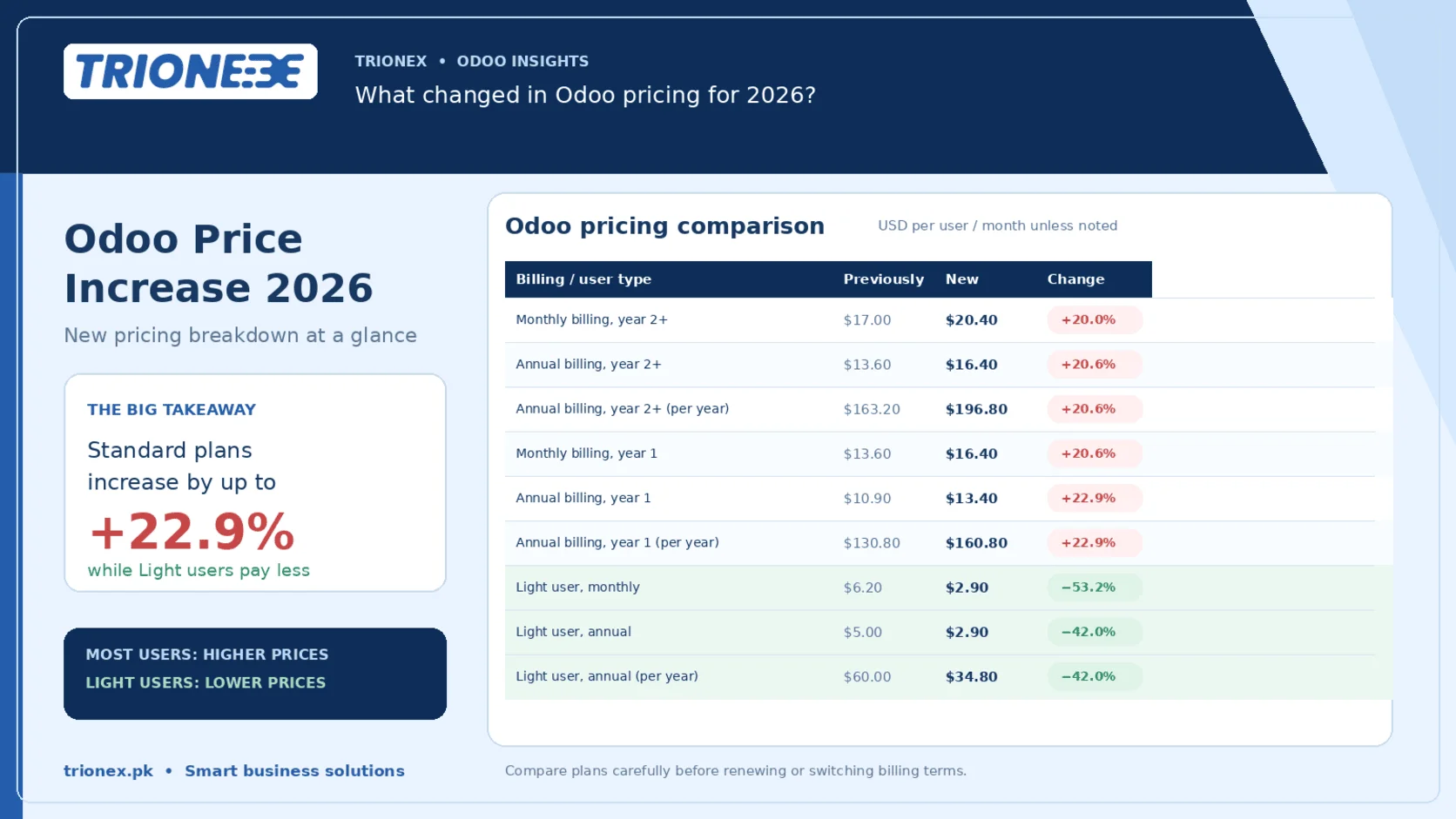
Odoo is raising per-user subscription pricing by 20% to 22.9% depending on which line you look at. For businesses in the Asia/Africa Low USD band — which is where Pakistan sits — the headline seat price moves from $13.60 to $16.40 per user per month on annual billing.
But buried in the same pricing change is something almost nobody is talking about: the light user seat is being cut from $5.00 to $2.90 per user per month on annual billing, a 42% reduction. For companies with the right user mix, the 2026 “price increase” is actually a price decrease.
Here is the complete breakdown, with the math.
The new Odoo pricing table (Asia/Africa Low USD band)
All figures are per user, per month in USD unless marked otherwise.
| Line | Previously | New | Change |
| Monthly billing, year 2+ | $17.00 | $20.40 | +20.0% |
| Annual billing, year 2+ | $13.60 | $16.40 | +20.6% |
| Annual billing, year 2+ (per year) | $163.20 | $196.80 | +20.6% |
| Monthly billing, year 1 | $13.60 | $16.40 | +20.6% |
| Annual billing, year 1 | $10.90 | $13.40 | +22.9% |
| Annual billing, year 1 (per year) | $130.80 | $160.80 | +22.9% |
| Light user, monthly | $6.20 | $2.90 | −53.2% |
| Light user, annual | $5.00 | $2.90 | −42.0% |
| Light user, annual (per year) | $60.00 | $34.80 | −42.0% |
Three structural things fall out of this table.
The first-year discount is getting shallower. Previously, new customers got $32.40 off the annual price — a 19.9% first-year discount. The new discount is $36.00 off a higher base, which is 18.3%. That narrowing is why year 1 rises 22.9% while year 2 rises only 20.6%. New customers absorb more of the increase than renewing ones.
Annual billing still saves you roughly 20%. Monthly billing costs $20.40 versus $16.40 on annual — a 19.6% premium for paying monthly, almost identical to the old 20.0% spread. If you’re currently on monthly billing, switching to annual cancels the entire increase and then some.
The purchasing-power discount is compressing. Against a US Standard list price of around $24.90, this band previously sat 45% below US pricing. At $16.40, it’s 34% below. The regional discount narrowed by about 11 percentage points. If Odoo continues normalising regional bands toward global list, expect further compression at the next version cycle.
The light user cut is the real story
Light user seats drop from $60.00 to $34.80 per user per year. That is a 42% reduction, landing in the same pricing change as a 20%+ increase on full seats.
Odoo is clearly steering customers toward a mixed-seat model: fewer expensive full users, more cheap restricted ones. If you license every employee as a full user today, you’re now paying a penalty you didn’t used to pay.
Confirm the entitlement scope with your Odoo partner before you restructure. The sheet gives the price, not the permission set, and what a light user can actually do determines whether this works for your operation.
The breakeven ratio
Let f = full users and l = light users.
- Old annual cost: 163.20f + 60.00l
- New annual cost: 196.80f + 34.80l
- Difference: 33.60f − 25.20l
This hits zero when l = 1.33f.
If light users make up more than about 57% of your total seats, your Odoo bill goes down in 2026, not up.
Worked example: 25-user company
| Seat mix | Old annual cost | New annual cost | Change |
| 25 full, 0 light | $4,080 | $4,920 | +$840 (+20.6%) |
| 18 full, 7 light | $3,358 | $3,786 | +$429 (+12.8%) |
| 14 full, 11 light | $2,945 | $3,138 | +$193 (+6.6%) |
| 10 full, 15 light | $2,532 | $2,490 | −$42 (−1.7%) |
| 6 full, 19 light | $2,119 | $1,842 | −$277 (−13.1%) |
A distribution business where warehouse staff, drivers and branch clerks only need restricted access pays less in 2026 than in 2025. Same company, same headcount, different seat structure.
What the increase actually costs, by company size
Full users only, annual billing, year 2 onward.
| Users | Old annual | New annual | Increase/year | Increase/month |
| 5 | $816 | $984 | $168 | $14 |
| 10 | $1,632 | $1,968 | $336 | $28 |
| 25 | $4,080 | $4,920 | $840 | $70 |
| 50 | $8,160 | $9,840 | $1,680 | $140 |
| 100 | $16,320 | $19,680 | $3,360 | $280 |
| 250 | $40,800 | $49,200 | $8,400 | $700 |
For a 25-user company, the entire increase is $70 a month — roughly one-fifth of a single junior clerk’s salary in Pakistan, or about what a mid-size office spends on internet and utilities in a week.
Three-year licence cost, 25 users (year 1 promo + two years at standard):
- Before: $3,270 + $4,080 + $4,080 = $11,430
- After: $4,020 + $4,920 + $4,920 = $13,860
- Increase: $2,430 over three years
Why the TCO number is what matters, not the licence number
Licences are only part of what an ERP costs. In Pakistan, Odoo implementation is delivered locally by partner teams whose rates have nothing to do with Odoo’s pricing decisions.
A realistic 25-user, mid-complexity rollout (sales, purchase, inventory, manufacturing, accounting, HR) through a Pakistani Gold or Silver partner:
| Line item | Cost |
| Implementation, data migration, training (one-time) | $10,000 – $14,000 |
| Annual partner support / AMC | $1,500 – $2,500/year |
| Licences, 3 years, post-increase | $13,860 |
Using midpoints of $12,000 and $2,000/year:
- Three-year TCO before: $29,430
- Three-year TCO after: $31,860
- Actual increase: 8.3%
A 20.6% licence increase moves three-year total cost of ownership by roughly 8%. Licences are about 44% of three-year TCO. The other 56% is local, quoted in rupees, and negotiable — which is where you should be spending your negotiating energy.
Why Pakistani businesses feel this more than most markets
Your costs are dollar-denominated; your revenue isn’t. The rupee has moved from roughly 155/USD in early 2021 to around 280/USD today. In local terms, that FX drift alone has already raised your Odoo bill about 80% over five years without Odoo touching a list price. A 20.6% list increase is smaller than what currency has already done — and unlike FX, it’s predictable and can be locked in.
Tax sits on top of the list price. Payments to a non-resident software vendor can attract withholding under Section 152, plus provincial sales tax on services (SRB, PRA, KPRA) depending on invoice structure, plus the digital-vendor levy introduced in the Finance Act 2025. Your effective cost is above the sticker. Have your tax adviser model it rather than assuming list = total.
Payment friction pushes you through a partner. Direct payment to Odoo SA requires a forex-enabled card or an outward remittance with documentation. Most Pakistani SMEs route through a local partner who invoices in PKR. Ask your partner explicitly whether they are passing through 20.6% or adding margin on top. That conversation is worth more than anything else in this article.
The real competitor is “nothing.” Pakistani SMEs aren’t choosing between Odoo and SAP. They’re choosing between Odoo and Excel plus a WhatsApp group. Every price increase widens the gap against doing nothing — which remains this market’s most-installed ERP.
Odoo vs the alternatives, after the increase
Per user, per month, annual billing where applicable.
| System | Cost/user/month | Multiple of Odoo |
| ERPNext / Frappe | $0 licence + hosting | — |
| Odoo (this band, new, year 1) | $13.40 | 0.8× |
| Odoo (this band, new, year 2+) | $16.40 | 1.0× |
| Odoo light user (new) | $2.90 | 0.18× |
| Zoho One (all-employee pricing) | ~$21 | 1.3× |
| Odoo Standard, US list | ~$24.90 | 1.5× |
| Zoho One (flexible) | ~$37 | 2.3× |
| Dynamics 365 Business Central Essentials | ~$70 | 4.3× |
| SAP Business One, cloud | ~$94–108 | 5.7–6.6× |
| NetSuite | ~$99 + $999–2,000/mo platform | 6× + platform |
| Dynamics 365 BC Premium | ~$100 | 6.1× |
Even after a 22% increase, Odoo in this band costs roughly one-quarter of Dynamics 365 Business Central Essentials and one-sixth of SAP Business One. Local perpetual-licence ERPs typically run $5,000–$50,000 upfront plus 15–20% annual maintenance, with smaller ecosystems and considerably higher key-person risk.
The ROI case, in dollars
Against salary cost. At $16.40 per user per month, an Odoo seat costs about 4.6% of the monthly cost of a PKR 100,000/month employee. You’re paying under a twentieth of a person’s cost to make that person measurably faster. A light user seat is 0.8%.
Against working capital. For a distribution business at $1 million annual revenue carrying $330,000 in inventory, with borrowing at a KIBOR-linked ~13.5%:
That’s 2.2× the entire annual licence bill for 25 users — before counting recovered stockoutrevenue, reduced write-offs, or the labour hours you stop spending on reconciliation.
Against the compliance clock. FBR’s digital invoicing integration mandate keeps pulling registered businesses toward systems that can talk to a government API. Most Pakistani Odoopartners have built FBR e-invoicing connectors, and Odoo ships a Pakistan localization with local chart of accounts and tax structures. The realistic alternative isn’t staying on Excel forever — it’s buying an ERP in a panic in 18 months, at a worse price, on a compressed timeline.
Six things to do before the new pricing takes effect
- Audit your seats and reclassify aggressively. This is the highest-value action on the list. Identify everyone who can work as a light user at $2.90 instead of a full user at $16.40. Every seat you move saves $162 per year. Moving 15 seats saves $2,430 — the entire three-year increase, recovered in year one.
- Move customers and vendors to portal access, which is free. If you’re licensing people who only view their own orders or submit documents, you’re paying for nothing.
- Lock in a multi-year contract at current rates. Odoo generally honours the contracted rate for the term. On 25 users, a three-year prepayment signed before the effective date protects roughly $2,430.
- Buy your growth seats now. Planning to go from 25 to 40 users over 18 months? Adding those 15 seats at $13.60 instead of $16.40 saves $504 per year for the contract term.
- Switch from monthly to annual billing. A 19.6% saving that roughly cancels the increase on its own.
- Get your partner quote in writing, with the FX rate stated. Ambiguity here is where 20.6% quietly becomes 30%.
When Odoo stops being the right answer
An honest post has to include this section.
- High headcount, low process complexity. At 300 warehouse users doing simple transactions, per-seat economics turn against you — though the $2.90 light user seat dramatically improves Odoo’s position here compared to a year ago. ERPNext, with no per-user licence at all, still deserves a serious evaluation at that scale.
- You can’t tolerate compounding increases. If ~20% moves recur every version cycle, three renewals compound to roughly +77%. Model that scenario before signing a one-year deal.
- You’ve customized heavily. Deep Odoo customization raises upgrade cost and weakens your negotiating position exactly when prices move, because switching becomes expensive.
- Odoo Community meets your needs. It’s free and open source. You give up Studio, full accounting, Documents, Sign, Helpdesk, Field Service, Quality, PLM and official support. For a small services firm with simple books, that trade sometimes works.
Frequently asked questions
How much is Odoo increasing prices in 2026?
Between 20.0% and 22.9% on full user seats, depending on billing line. Monthly billing rises 20.0%, standard annual billing rises 20.6%, and first-year annual pricing rises 22.9%. Light user seats decrease by 42%.
What is the new Odoo price per user in Pakistan?
In the Asia/Africa Low USD band, $16.40 per user per month on annual billing from year two, $13.40 in year one, or $20.40 on monthly billing. Light users are $2.90 per user per month.
Is the Odoo light user price going down?
Yes. Light user seats drop from $5.00 to $2.90 per user per month on annual billing — a 42% reduction — and from $6.20 to $2.90 on monthly billing, a 53% reduction.
Can I avoid the Odoo price increase?
Largely, yes. Signing a multi-year contract before the effective date locks current rates for the term. Switching from monthly to annual billing saves 19.6%. Reclassifying eligible seats as light users saves $162 per seat per year and can offset the increase entirely.
How much does a full Odoo implementation cost in Pakistan?
For a 25-user mid-complexity rollout through a local partner, expect $10,000–$14,000 one-time plus $1,500–$2,500 per year in support. Licences are roughly 44% of three-year total cost of ownership.
Is Odoo still cheaper than SAP or Microsoft Dynamics after the increase?
Yes, substantially. At $16.40 per user per month, Odoo remains roughly one-quarter the cost of Dynamics 365 Business Central Essentials and one-sixth the cost of SAP Business One cloud.
The bottom line
The 2026 Odoo price increase costs a 25-user company $840 a year, or $70 a month — an 8% move on three-year total cost of ownership against a system that can free $80,000 of working capital per $1 million of revenue.
But the smarter read is that this isn’t a price increase at all. It’s a price restructure. Odoo made full seats 20% more expensive and light seats 42% cheaper, and it’s betting most customers won’t notice the second half. Companies that restructure their seat mix will pay less in 2026 than they did in 2025. Companies that license everyone as a full user will pay 20.6% more and never know they had a choice.
Audit your users before you renew. That single exercise is worth more than the entire increase.
Tagged with :