Choosing between Odoo and Zoho is not really about which one has more features. Both platforms can run your sales, finance, and operations. The real question is how they are built, and which structure fits the way your business actually works. This guide breaks down the real differences so you can pick with confidence.
Odoo vs Zoho at a Glance
| Criteria | Odoo | Zoho |
|---|---|---|
| Platform type | Open-source ERP | Cloud-based app suite |
| Core strength | Connected operations across departments | CRM, marketing, and productivity apps |
| Best for | Growing businesses with complex or connected processes | Businesses that want fast setup with less technical work |
| Customization | Deep, through Odoo Studio and custom development | App-level, through Zoho Creator and low-code tools |
| Manufacturing | Full MRP, BOM, work orders, quality, maintenance | Not a core strength |
| Community edition | Free, open source, self-hosted option available | No free plan for Zoho One; individual apps like Zoho CRM offer a limited free tier |
| AI features | AI in CRM, Accounting, and Inventory across modules | Zia AI built into CRM and select apps |
What is Odoo?
Odoo is an open-source ERP platform built around connected modules. CRM, Sales, Inventory, Accounting, Manufacturing, HR, and more all run inside one system, sharing the same data. A sales order can update stock, trigger an invoice, and feed into accounting automatically. Odoo works well for businesses whose departments depend on each other.
What is Zoho?
Zoho is a cloud suite of more than 50 apps, often sold together as Zoho One. It covers CRM, finance, HR, marketing, and collaboration, but each app behaves more like a standalone tool connected through the Zoho ecosystem rather than one unified system. Zoho is a strong fit for teams that want ready-to-use apps without building a full ERP structure.
CRM and Sales
Zoho CRM is a strong standalone sales tool. It offers pipeline tracking, dashboards, and marketing automation, and it works well for sales-led teams that mainly need to manage leads and deals.
Odoo CRM goes a step further by connecting directly to operations. A confirmed deal in Odoo can move into a quotation, a sales order, delivery, and an invoice, all inside the same system. This matters when a sale needs to trigger stock updates or production, not just a follow-up email.
- Zoho CRM: best for standalone sales pipelines and marketing-led teams
- Odoo CRM: best when sales needs to connect with inventory, delivery, and finance
Accounting and Finance
Zoho books handles standard finance needs well: invoicing, expenses, and everyday bookkeeping. It is easy to set up and works fine for businesses with simple financial workflows.
Odoo accounting is built to stay close to operations. Because it shares data with sales, purchase, and inventory, financial reports reflect what is actually happening in the business in real time, not what gets entered later. For businesses in Pakistan, this also matters for FBR e-invoicing, since accounting needs to stay compliant with local tax rules as transactions happen.
Inventory and Supply Chain
This is where the gap widens. Zoho Inventory covers stock tracking, batch numbers, and multi-warehouse basics, which is enough for simpler stock control.
Odoo inventory supports multi-warehouse operations, barcode scanning, replenishment rules, and stock valuation tied directly to accounting. For distribution, trading, or retail businesses where stock accuracy affects both delivery and financial reporting, Odoo from a certified Odoo partner generally handles the complexity better.
Manufacturing
Zoho does not compete strongly here. It can support light production tracking through add-ons, but it was not built for manufacturing.
Odoo manufacturing includes bills of materials, work orders, quality checks, and maintenance scheduling, all connected to inventory and purchasing. If your business makes products rather than just sells them, this is usually the deciding factor.
HR and Marketing
Zoho has an advantage in sheer app variety. Its HR, marketing, and collaboration tools are mature and easy to adopt on their own.
Odoo covers the same ground with employees, recruitment, time off, payroll, and marketing automation, with the added benefit that project work, timesheets, and invoicing can connect directly to HR and marketing data instead of living in separate silos.
AI features in Odoo and Zoho
Both platforms have added real AI in recent versions, though this rarely gets covered in most comparisons.
- Zoho’s Zia AI assists with lead scoring, sentiment analysis, and basic forecasting inside Zoho CRM.
- Odoo’s newer AI features go further across modules: smarter lead scoring in CRM and automated invoice data capture in accounting, with demand forecasting for Inventory available through Odoo’s app marketplace.
If AI-assisted automation across multiple departments matters to you, it is worth asking any implementation partner which AI capabilities are actually configured versus just available.
Customization and Flexibility
Zoho supports customization mainly through Zoho creator, a low-code tool for building custom apps and forms. It works well for moderate changes without needing a development team.
Odoo allows deeper customization. Odoo studio lets you adjust fields, views, and workflows without code, and for more complex needs, the open-source codebase can be extended directly. This flexibility is powerful, but it needs good governance so customization does not get out of hand during future upgrades.
Pricing Philosophy
Zoho typically bundles its apps under one suite price, which makes budgeting simpler upfront. Odoo prices more modularly, based on which apps you use and how many users you have, with a free community edition available for businesses that want to start small. Neither model is automatically cheaper. The real cost depends on implementation, customization, and support, which our Odoo cost guide breaks down in more detail.
Which Platform Should You Choose?
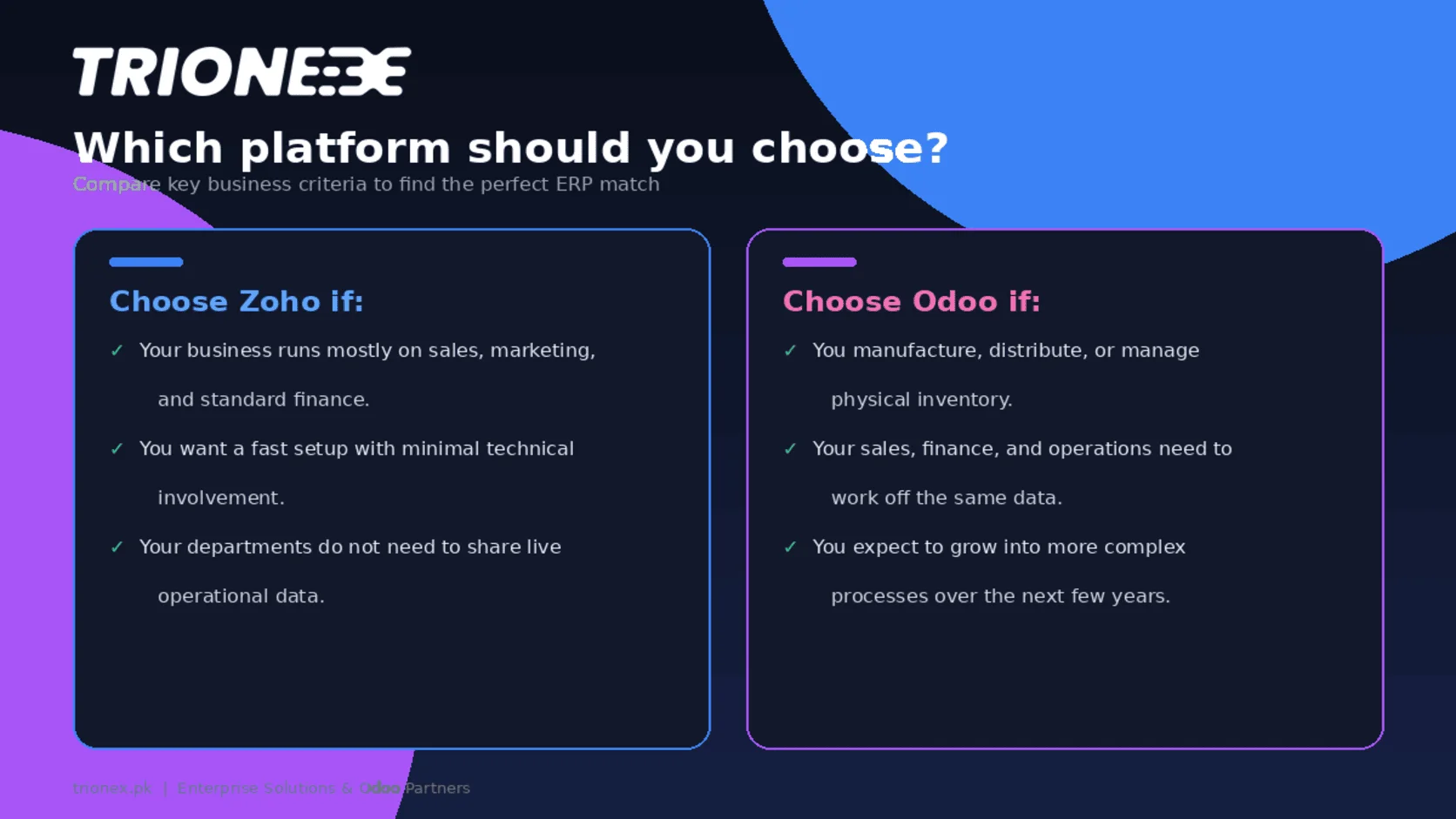
Choose Zoho if:
- Your business runs mostly on sales, marketing, and standard finance
- You want a fast setup with minimal technical involvement
- Your departments do not need to share live operational data
Choose Odoo if:
- You manufacture, distribute, or manage physical inventory
- Your sales, finance, and operations need to work off the same data
- You expect to grow into more complex processes over the next few years
You can also know about the Odoo vs SAP.
Making the Right Call
The right platform comes down to one question: how much do your departments actually depend on each other? If the answer is not much, Zoho will likely get you running faster. If a sale needs to ripple through stock, production, and your books the moment it happens, Odoo is built for that. Trionex is an Odoo silver partner based in Lahore, with implementations delivered for brands like Sapphire, Tim Hortons, and Subway across manufacturing, retail, and food service in Pakistan. If your business is leaning toward Odoo but you want a clearer picture of what implementation actually involves, our Odoo implementation team can help you map it out.
Frequently Asked Questions
Is Odoo better than Zoho?
Odoo tends to fit connected, operations-heavy businesses, while Zoho fits businesses that want fast, standalone apps.
Which is cheaper, Odoo or Zoho?
It depends on your setup. Zoho’s bundled pricing is easier to predict upfront, but Odoo’s modular pricing can cost less if you only need a few apps.
Can Odoo replace Zoho CRM specifically?
Yes. Odoo CRM covers the same core functions as Zoho CRM, with the added ability to connect directly to sales orders, inventory, and invoicing.
Is Zoho suitable for manufacturing businesses?
Not really. Zoho was not built for manufacturing workflows. Odoo is the stronger choice if production planning is part of your business.
Does Odoo work for small businesses just starting out?
Yes. Odoo’s free Community edition lets small businesses start with just the apps they need and expand later.