Running a business means managing a lot of moving parts. Purchase orders, inventory levels, sales pipelines, payroll, invoices, customer records. Most companies start by handling each of these in isolation: a separate accounting tool, spreadsheets for stock, a standalone HR system, and a great deal of manual reconciliation in between.
At some point, the gaps between those tools become a genuine operational problem. A sale gets confirmed on stock that has already been committed elsewhere. A vendor invoice does not match the purchase order because something changed in transit. Month-end close takes two weeks because data has to be pulled from three different systems and checked by hand.
Odoo is the platform built to solve this. It is one of the most widely adopted enterprise resource planning (ERP) systems in the world, open-source, modular, and designed around the idea that business software should connect operations rather than complicate them. This guide covers what Odoo is, what it can do, how it is structured, and why it has become the platform of choice for businesses across manufacturing, trading, retail, and services sectors, including a rapidly growing number of companies in Pakistan.
What is Odoo?
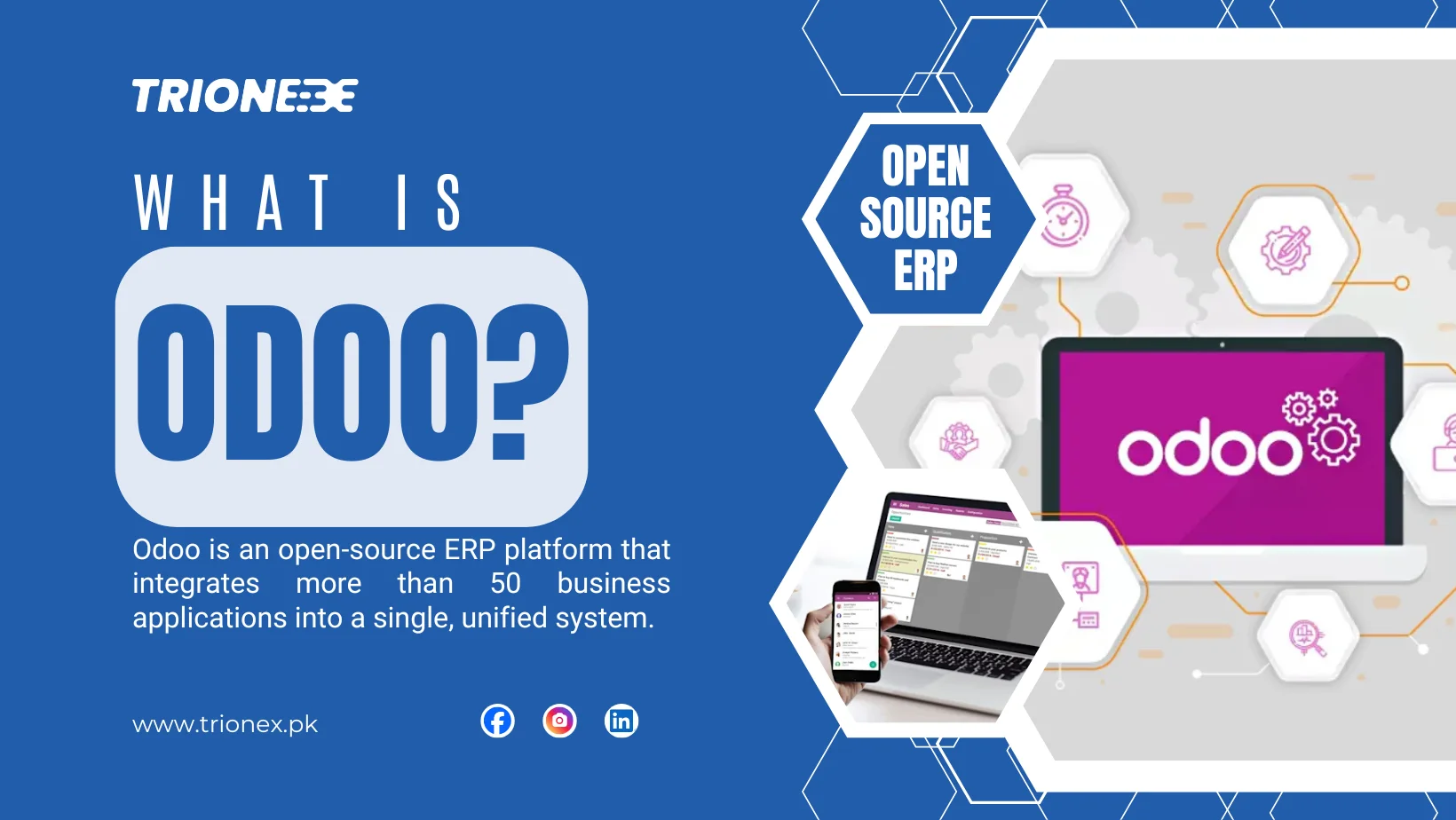
Odoo is an open-source ERP platform that integrates more than 50 business applications into a single, unified system. Sales, purchasing, inventory, accounting, manufacturing, human resources, payroll, project management, e-commerce, and marketing all run on a shared database, updated in real time, and accessible through one interface.
The practical significance of that architecture is hard to overstate. When a sales team in Lahore confirms an order, the warehouse team sees the delivery task immediately. The finance team sees the receivable. The purchasing manager sees whether stock needs to be replenished. Nobody sends an update email. Nobody re-enters data into a second system. Information moves because the system is designed to move it.
Odoo was founded in Belgium in 2005 by Fabien Pinckaers, initially as Tiny ERP, a lightweight open-source accounting project. It grew quickly, rebranded to Open ERP in 2009 as its scope expanded, then became Odoo in 2014 to reflect its evolution into a complete business management suite. Today, it serves more than 12 million users across 175 countries, with an ecosystem of over 40,000 third-party applications built on its open framework.
That scale of adoption matters for a practical reason: a platform used by 12 million businesses in 175 countries is not going away. The long-term investment is sound.
What Does Odoo Stand For?
The name is most widely interpreted as “On Demand Open Object.” Odoo S.A. has not published a single official definition, but the phrase captures the platform’s design principles clearly.
On-Demand means accessible anywhere, through a browser or mobile app, deployed either in the cloud or on your own servers. The system is available when and where your team works, not anchored to a specific machine or office.
Open means built on open-source foundations. The Community Edition source code is publicly available, auditable, and extensible. No proprietary black boxes are hiding how the system behaves.
Object refers to the object-oriented, relational data model underlying the framework. This is what makes Odoo highly configurable. Different businesses can shape it to very different workflows without needing to modify the core codebase.
The earlier names told a simpler story. TinyERP was small and open-source. OpenERP emphasised the platform’s ERP roots. The 2014 rebrand to Odoo signalled a broader ambition: a complete business operating system for companies of any size, in any sector.
What is Odoo Used For?
Odoo’s modular structure means the answer depends on which applications a business activates. You can run two modules or twenty, check from Odoo modules list. Here is what the major ones actually cover.
Sales and CRM
Lead and opportunity tracking, pipeline management, quotation generation, and sales order processing are all connected in one workflow.
Accounting and Finance
Odoo Accounting is a full double-entry system, not a simplified bookkeeping interface. It handles invoicing, vendor bills, bank reconciliation, multi-currency transactions, tax management, including Pakistani FBR e-invoicing and withholding tax requirements, budgeting, and financial statements.
Businesses currently running a standalone accounting package typically find that removing the integration overhead between it and their other systems is one of the most immediate gains from switching to Odoo.
Inventory and Warehouse Management
Real-time stock visibility across multiple locations, automated reorder rules, barcode scanning, and serial and lot number tracking are standard capabilities. The module supports simple operations, such as a single godown with straightforward FIFO stock, as naturally as it handles multi-warehouse complexity.
Because it shares data with purchasing and sales, stock levels always reflect actual committed quantities rather than last week’s export.
Manufacturing (MRP)
Bills of Materials, production orders, work centre scheduling, quality control checkpoints, and product costing all sit within the same system that handles sales and inventory.
For manufacturing businesses in Pakistan’s textile, pharmaceutical, FMCG, and engineering sectors, this integration eliminates the disconnect between production planning and commercial operations that generates most of the costly surprises in manufacturing businesses.
Human Resources and Payroll
Employee records, contracts, attendance, leave management, appraisal cycles, and recruitment are all covered. Payroll is configurable for Pakistani requirements: income tax slabs, EOBI and PESSI deductions, and custom salary structures.
Attendance data feeds directly into payroll calculation without a monthly export to a separate payroll tool.
Purchase and Procurement
Requests for quotations, purchase orders, vendor management, goods receipt, and three-way matching between purchase orders, receipts, and vendor bills make the procurement cycle auditable from end to end.
This matters significantly when bank relationships, auditors, or tax authorities ask for documentation of procurement decisions and payment approvals.
E-Commerce and Website
Odoo includes a built-in website builder and e-commerce engine that shares the product catalogue and inventory directly with the rest of the system. Products published online are the same records that the warehouse tracks. Orders placed on the website enter the same fulfilment process as orders placed by the sales team.
For businesses running both online and physical sales, this removes the painful reconciliation work that comes with maintaining a separate Shopify or WooCommerce store alongside an ERP.
Project Management
Kanban boards, Gantt charts, task assignments, time tracking, and billable hour management serve IT firms, consulting practices, construction companies, and any service business that needs to track project delivery against client contracts and connect it directly to invoicing.
Point of Sale
Tablet and desktop compatible, with offline mode and automatic sync to inventory and accounting, Odoo POS is built for retail chains, restaurants, and service outlets that need a point-of-sale system genuinely connected to the rest of the business rather than a standalone register reconciled manually at end of day.
Marketing Automation and Email
Automated campaigns, audience segmentation, bulk email, and SMS marketing connect directly to the CRM module, so campaign activity feeds straight into the sales pipeline.
For businesses currently managing marketing in one tool and tracking leads in another, the integration removes a significant manual workflow. It prevents leads from falling through the gap between the two systems.
Is Odoo Open Source?
Yes, though the full picture is worth understanding before making a decision.
Community Edition: Free and Open Source
The Community Edition is distributed under the LGPL licence. It is free to download, deploy, use, and modify. The source code is publicly available on GitHub. Core modules, including CRM, Sales, Inventory, Purchasing, Accounting, Manufacturing, and HR, are all included at no cost.
For businesses with technical capability, the Community Edition is a serious starting point. It is also the foundation on which certified Odoo services build localisations, custom modules, and industry-specific extensions. The open-source model is a strength rather than a compromise, because it means the ecosystem grows continuously and the code can always be audited and adapted.
Enterprise Edition: Subscription-Based, Substantially More Complete
The Enterprise Edition is a paid subscription priced per user per month. It is built on top of the Community Edition. It adds a more refined interface, full mobile application support, cloud hosting through Odoo.sh, and additional modules not available in Community. Notable additions include:
- Odoo Studio, a no-code customisation tool for building views, automations, and reports without writing code
- Advanced Accounting with IFRS-compliant reporting
- Sign, for electronic document signing integrated natively into workflows
- Field Service Management for businesses with mobile technicians or on-site service teams
- Enhanced Marketing Automation with more granular audience segmentation and campaign control
The subscription cost is a fraction of what SAP Business One, Microsoft Dynamics 365, or Oracle NetSuite charges, even before accounting for implementation and maintenance fees. For most Pakistani businesses evaluating ERP options, Odoo Enterprise sits in an entirely different cost bracket than its closest competitors while covering the same functional ground.
Deciding between Community and Enterprise depends on specific requirements and team capability. A proper Odoo implementation process includes this assessment as part of scoping, with a recommendation based on what actually fits rather than what carries the higher margin.
Why Trionex for Odoo in Pakistan?
Trionex is a Pakistan-based technology firm specialising in Odoo implementation, customisation, and enterprise digital transformation. Certified consultants and developers have delivered implementations across manufacturing, trading, retail, services, and technology sectors, covering businesses from family-owned SMEs to multi-location operations.
The Odoo services Trionex provides span the full project lifecycle:
- Requirements analysis
- System configuration
- Odoo customization
- Module development
- Data migration
- User training
- Go-live support
- And ongoing maintenance
Both Community and Enterprise editions are supported, and the recommendation is always based on what fits the business rather than what carries a higher margin.
The team understands the local compliance landscape: FBR e-invoicing, withholding tax structures, Pakistani payroll legislation, and the operational realities that do not appear in global Odoo documentation.
That local knowledge shortens implementation timelines and reduces the configuration cycles that occur when an international team is learning the regulatory environment alongside the business itself.
Conclusion
Odoo is not the right choice for every business in every situation. No ERP is. There are companies with highly specialised requirements, unusual regulatory environments, or industry-specific workflows that need significant customisation before Odoo fits well. That assessment should happen at the scoping stage, with clarity and honesty.
For businesses at the growth stage managing real operational complexity, dealing with the coordination costs of disconnected systems, and looking for a platform that can scale with them, Odoo offers something genuinely useful: enterprise-grade integration capability, open-source flexibility, a thriving global ecosystem, and pricing that makes return on investment achievable rather than theoretical.
In Pakistan specifically, where the combination of local compliance requirements and limited ERP budgets has historically pushed businesses toward inadequate tools, Odoo represents a real option for companies that want to operate at a higher level of efficiency without the costs that have traditionally made that inaccessible.
If you want an honest assessment of what Odoo would look like for your specific business, what would work out of the box, what would require Odoo customization, and what a realistic budget and timeline looks like, get in touch with the Trionex team. We will give you a straight answer.
Tagged with :